
“Blessed be the God and Father of our Lord Jesus Christ, the Father of mercies and God of all comfort, who comforts us in all our affliction, so that we may be able to comfort those who are in any affliction, with the comfort with which we ourselves are comforted by God.”
(2 Co 1:3–4).
In a Lawless World, God offers Peace, Order, Truth, and Comfort
In my prior blog post, Fleeing Wickedness and Seeking Righteousness: The Growing Desire for Spiritual Growth, I presented the results of a recent poll which indicated that a growing number of people expressed a desire to grow spiritually. (Please read that post before this one as that post is a foundation of which this one builds on). My opinion is that people are being forced to a breaking point due to the growing evil and wickedness which is affecting their everyday lives and a solution is nowhere to be found. They are seeking a return of peace, truth, honesty, order, morality, and goodness. The Apostle Paul addresses this problem in (1Tim. 6:11), where the solution is for the man of God to flee wickedness and pursue righteousness. This is the answer to what people are looking for. By desiring spiritual growth, and in seeking righteousness, they are actually pursuing closeness to God. Surrounded by an ever-growing darkness people are attracted to the God of light. They wish to access the source of all that is good. They desire the holiness, purity, and peace that flows from the fountain of God’s nature.

At different ages in time, society will fall into a state of spiritual decline where violence, corruption, moral depravity, and godlessness are out of control. 18th century England was such a place. It was described as being one of the most brutal, rowdy, riotous, cruel, and bloodthirsty nations in the world. Drunkenness was a common problem which intensified the situation. People wished for an escape from the wickedness to a new era of spiritual growth. In response a new movement of evangelical preachers such as John Wesley and George Whitefield brought about the Great Awakening. These preachers faced hostile mobs who often beat and harassed them for bringing their sinful deeds into the light. We find ourselves in similar times as this current society is in rebellion against God and His people. As was then, many people now, are seeking a new era of spiritual growth.
Those who are not yet believers, must first come to faith in Christ to begin their journey to spiritual growth. For believers, spiritual growth requires that they progress in their own sanctification process. Their issue may be that they have become stalled in their spiritual growth or have become lukewarm in the faith because they have lost relationship with God. There is also a lack of instruction in doctrine in many of the churches today that neglect preaching and teaching the full Council of God. Without proper instruction far too many Christians lack the understanding needed for spiritual growth. These instructions are written in the pages of the Bible, but in the current state of Christianity many believers do not read it or know the fundamental teachings of the faith. Provided for you in the following sections is an explanation of spiritual growth and directions for achieving it. May my instruction provide guidance for your path to your growth in Christ.
Spiritual Growth Defined
What is meant by spiritual growth and why is it necessary in the Christian Life? To understand spiritual growth, it is necessary to have a grasp of the Christian life from the time the believer accepts Christ to the day of his/her death and passes into eternal life. Briefly stated, this time can be divided into two stages, justification and sanctification. Justification is the moment when a person accepts Christ as their savior by faith. At the time of justification, the believer is viewed as a new babe in Christ. He is a sinner who has been saved and declared righteous through his faith in the work of Christ on the cross. He has crossed over from darkness into light, but he still carries much of his old habits and the pollution of sin. A transformation process must take place where the believer’s mind is transformed by the renewing of the mind, (Rom. 12:2). This process is also called progressive sanctification, where the believer grows into a mature Christian whose mind is conformed to the mind of Christ and grounded in the teachings of the faith. Spiritual growth of the believer and this transformation is achieved by learning and applying God’s truth to his/her life. It is also dependent on the believer’s union with Christ and the work of the Holy Spirit, who is the agent of spiritual growth. The Spirit indwells them, convicts them of sin, and transforms them into the image of Christ. The Union with Christ and the work of the Holy Spirit in Sanctification are the foundations of sanctification and spiritual growth. Understanding these teachings help prepare the believer for the necessary relationship between him/her, Christ, and the Holy Spirit.
Being in union in Christ means that the believer is actually in Christ, and Christ is in him. This is explained by the Apostle John in, (1 John 3:24). Being in Christ means that we abide in Him, and by abiding in Christ, the believer is able to draw from the fountain of Christ to replenish his/her faith and nourish his/her spirit. The path of spiritual growth in sanctification is related to the ability of the believer to embrace the indwelling Christ and to draw on Him for spiritual nourishment.
The work of the Holy Spirit in spiritual growth centers on two aspects; the leading of the Spirit, and the filling of the Spirit. To be led by the Spirit means that the believer resists their own inclination toward sin, but is guided by the Spirit toward righteousness by conforming to the will of God and obedience to His commandments. The filling of the Spirit is the believer’s submission to the power of Spirit in the control of their life. As a Christian matures in the faith, they transfer more and more control over their life from the self over to the Spirit. The greater the Spirit controls the believer the more they resemble Christ. Simply put, the leading of the Spirit is to be guided by the Spirit; and the filling of the Spirit is submission to the control of the Spirit.
Necessity of Spiritual Growth
The necessity for spiritual growth is written throughout the scriptures. Christians are to be salt and light on the earth to bring those that are lost from the Kingdom of Darkness, and into the Kingdom of Light. The Great Commission given by Christ to His disciples prior to His accension after the resurrection is the command, to make disciples of all nations, and to teach them to observe all the things that He had commanded them to, (Matt, 28:19-20). These tasks require mature believers who are knowledgeable in the teachings of Christ, and not unskilled believers who are still infants in the faith. Believers are expected to grow in maturity, and those that don’t are chastised for being slow and immature:
“For though by this time you ought to be teachers, you need someone to teach you again the basic principles of the oracles of God. You need milk, not solid food, for everyone who lives on milk is unskilled in the word of righteousness, since he is a child.“
(Heb. 5:12-13)
Sanctification and Christlikeness
The purpose and goal of sanctification is to be conformed to the image of Christ, which is also expressed as growing into Christlikeness. For those not familiar with the concept of Christlikeness it is best explained in the following quote from H.W. Holloman:
“But understanding precisely how Scripture relates Christlikeness to spiritual growth is not so obvious for many Christians.
Holloman, H. W. (1994). The Relation of Christlikeness to Spiritual Growth. Michigan Theological Journal, 5(1), 57–85.
To clarify concepts, we may define Christlikeness as “a Christian’s relative similarity to Christ’s perfect character and conduct exemplified in His earthly humanity.” Spiritual growth means that “God transforms Christians into greater Christlike maturity by His Spirit and through their biblical obedience.”
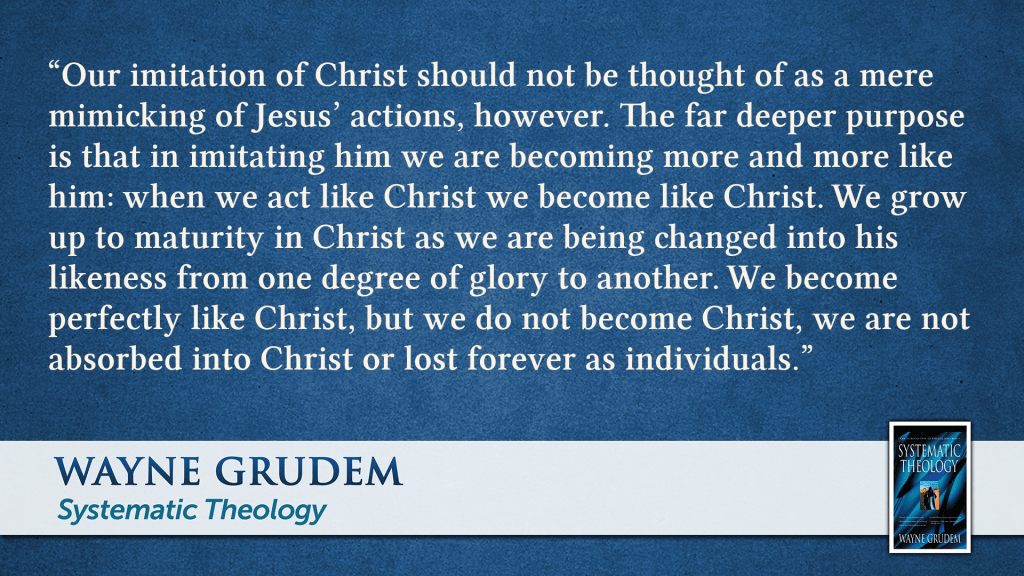
Since Christlikeness is the goal of sanctification and the reason for spiritual growth, how does the believer apply this in his everyday life? The simple answer is that he/she is to model their actions, conduct, and behavior according to the life of Christ as described in Scripture. Reading the gospels of Matthew, Mark, Luke, and John give accounts of Christ’s actions, conduct, and behavior. Jesus commanded His followers to learn and imitate His life in several scripture verses, “Take My yoke upon you and learn from Me, for I am gentle and humble in heart, and you will find rest for your souls,” (Matt. 11:29).” Examples of imitating Christ are having the qualities of being humble, gentle, loving, compassionate, caring, obedient, wise, protective, and righteous. It is important to remember that Christlikeness refers to the work of Christ in His earthly ministry where he took on a human nature and lived a perfectly sinless life so that He could be the perfect sacrifice to atone for mankind’s sins on the cross. While this is impossible for man, it could only be achieved by God. Therefore, we can only imitate Him to the degree that is possible knowing that we can never achieve sinlessness in these mortal bodies. Also, the Christian life is a constant struggle where we are in engaged in warfare against the world, the devil, and the desires of the flesh. Our spiritual strength is dependent on the power of the Spirit and our union with Christ, so it is imperative to nurture those relationships. Wayne Grudem, in his Systematic Theology textbook offers great insight into the imitation of Christ.
Summary
Spiritual growth is the sanctification process where the outcome is to be conformed to the image of Christ through the transformation of the mind. It requires study of the Scriptures, and the power of the Spirit who brings us into a union with Christ. It is a process that is dependent on God and requires the work of the believer to achieve growth through faith and submission to the Spirit. Becoming Christlike requires knowing Christ through study of His word and being in relationship with Him. Maturing in the faith is not an option, but a duty as explained in Hebrews 5:12-13. Christians are expected to be instruments of God for advancing the Kingdom through proclaiming the Word, teaching others, and in loving their neighbors.
The present desire for spiritual growth is the manifestation of the human longing for God. Those who are suffering through the efforts of dark spiritual forces to corrupt God’s creation through the spread of evil, hatred, violence, wickedness, and degeneracy—look for relief from the only power capable of restoring order, peace, and righteous conduct, which is the Almighty God. For those who truly seek Him, will find Him. Christ, because He was lifted up on the cross for our salvation has declared that He draws people to Himself, (John 12:32-33). If you are among those fleeing wickedness and seeking righteousness, then draw close to Christ and obtain His righteousness through faith. I leave you with the following quote from G.C. Newton to reinforce this instruction on spiritual growth, may it bring comfort and growth.
“God is ultimately responsible for the growth process in our lives from beginning to end. He chose before the world was created to make us a part of His garden where we could grow into the holy likeness of His Son, Jesus (Eph. 1:4). His plan was not only to save us, as important as that transformational experience is, but also to continue to nurture us into His likeness. His role as the Gardener is not finished when the seed takes root. Rather, His role in our spiritual development has just begun. The Holy Spirit works as a supernatural catalyst throughout our life. He first brings us into a personal relationship with Jesus and then molds us into His likeness. “He who began a good work in you will carry it on to completion until the day of Christ Jesus” (Phil. 1:6). God is ultimately responsible for all spiritual growth in the believer’s life. Additionally we are challenged to “make every effort” to build on what God has given. God’s provision for our growth becomes the reason why we should diligently work toward Christlike qualities.”
Newton, G. C. (2004). Growing toward spiritual maturity (p. 12).
 Hosea 4:6 Teaching Ministry
Leave a comment