The Night Visions
The prophecies of Zechariah are distinctive from other prophets because they are presented mostly in the form of visions which provide much material for this teaching series. The book of Zechariah begins with a series of eight visions which are known as the Night Visions because Zechariah received all eight visions in one night. A brief introduction to Zechariah and the background surrounding his prophetic ministry will help shed light on his visions.
Background– The Israelites had a history of breaking God’s covenant through their continued idolatry and disobedience to His commands by engaging in wickedness. This became increasingly worse during reign of Israels kings following the reign of King Solomon. God raised a series of prophets to warn the people of impending judgment if they did not repent. They responded by ignoring the warnings, rejecting God and killing some of the prophets, causing God’s wrath to fall on them through the conquests of the Assyrians and the Babylonians. Their cities were destroyed, and they were taken into captivity. Jerusalem was conquered and destroyed in 586 BCE by the Babylonians and several of the Israelites were taken captive to Babylon. The prophet Ezekiel warned the Israelites in the Southern Kingdom and Jerusalem of the impending judgment, but they did not heed his prophetic warnings and the city was destroyed. The captives were that taken to Babylon were held for a period of 70 years before they allowed to return. The prophet Daniel and the events in his book occurred during this exile in Babylon. Zechariah was born during the captivity and was a young priest when the Israelites returned to Jerusalem which still lay in ruins. The people were tasked by God to rebuild the temple and resume their worship. The Israelite exiles were a conquered and discouraged people who faced many challenges and obstacles. To their credit, their experience in captivity had brought them to repentance and to observe God’s laws and covenants. In response, God brought encouragement and hope to the people through the messages given to His prophets Zechariah and Haggai. It is in this arena that Zechariah ministers to his people, and in which he receives his visions as God’s instrument to motivate them.
The Eight Visions

The book of Zechariah begins with a rebuke from God to the Israelites for having deserted Him and engaging in evil deeds. God calls on the people to return to Him through repentance so that He can return to them according to the covenants that He made with Abraham and Moses. Following their repentance, God offers them hope and blessings for the restoration of the nation and its people. The Lord works through the prophet Zechariah by delivering eight visions which reveal messages that are to be given to the people for their support. The visions are focused on rebuilding the temple and the city, the restoration of the priests and community leaders, and the spiritual cleansing of the land.
Vision #1-The Man on a Red Horse Among the Myrtle Trees
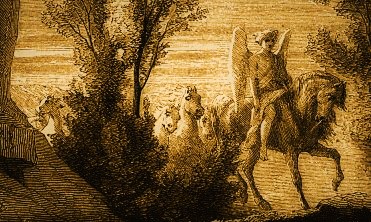
Zechariah’s visions begin when he is shown an image of a man riding a red horse who is standing in a ravine of myrtle trees, behind him are angels mounted on red, brown, and white horses. The man on the red horse turns out to be the Angel of the Lord, who is the preincarnate Christ, in the role as the Captain of the Lord’s army who commands the mounted angels. The mounted angels are assigned to patrol the earth, and they report their findings to the Angel of the Lord by declaring, “We have patrolled the earth, and behold, all the earth is peaceful and quiet.” The vision is interpreted as a message of hope for Israel as the Angel of the Lord intercedes for the nation and the people expressing His love for them, and in condemning the nations that came against them. The Lord speaks to the repentant Israelites with gracious and comforting words, promising to rebuild the temple and restore Jerusalem.
Vision #2-The Horns and the Craftsmen
In this vision, Zechariah is shown four horns and four craftsmen. The four horns symbolize four powerful kingdoms that were responsible for the destruction of the northern and southern kingdoms of Israel. The four craftsmen are God’s agents of retribution who bring judgment on the four horns. The message is intended to provide courage to the people by demonstrating God’s sovereignty over all nations and His return as the defender of Israel.
Vision #3-A Man with a Measuring Line

This vision focuses on Jerusalem and its future where Zechariah is shown an image of a man with a measuring line in his hand. The man explains that he is measuring Jerusalem because it will no longer have walls because it will be filled with a great many people and cattle. Also, walls will not be necessary because God will be a wall of fire around the city to protect it. The glory of God will return to the city as He declares that He will be the glory in their midst. God’s glory had left the city because of the idolatry and the wicked abominations which were being committed in the temple of the Lord by the priests just prior to the destruction of the city by the Babylonians. “Then the glory of the LORD departed from the threshold of the temple and stood over the cherubim,” (Ezek. 10:18).
Vision #4-The Restoration of Joshua the High Priest

The vision of Joshua the High Priest is a message signifying the reestablishment of the priestly office. Joshua is shown in a courtroom setting before the Angel of the Lord as he is accused by Satan. The Lord rebukes Satan and cleanses Joshua of his iniquity through a symbolic removal of his filthy clothing and replacing them with clean and purified garments which represent God’s righteousness. The vision ends with promises of blessings for Joshua and the priestly order if they continue to observe God’s ways and remain faithful.
Vision #5-A Lampstand and Two Olive Trees
In the fifth vision, Zechariah is shown a golden lampstand standing between two olive trees. The lampstand contains seven lamps and seven spouts which symbolize God’s presence among His people. The olive trees which supply oil to the lampstand represent the leaders of Israel who will oversee the rebuilding of the temple and Jerusalem. This is another message of encouragement for the Israelites to help them overcome the obstacles they faced.
Vision #6-A Flying Scroll

In the next two visions God addresses the issues of sin and wickedness which had defiled the land and the people. In this vision, Zechariah is shown a flying scroll which contains the judgment of God against those who steal and swear falsely, (which is to commit perjury and present false testimony against another). The scroll presents a curse against those who are thieves and false witnesses. The message presented is that divine judgment is at hand and God’s commandments are still in force.
Vision #7-The Woman in a Basket
Wickedness in the form of a woman confined in a basket is the vision that is shown to Zechariah to display God’s intention to purify Israel. An angel shows Zechariah an image of a large basket covered by a heavy lead cover. The cover is removed, and Zechariah sees a woman sitting inside the basket. When Zechariah asks what the image means, the angel’s response is quite clear, “This is Wickedness!” And he thrust her down into the basket, and threw the lead cover over its mouth,” (Zech. 5:8). The basket is then carried away to Babylon, (the center of wickedness), by two winged women. The message displays God’s removal of sin from the land.
Vision #8-The Four Chariots
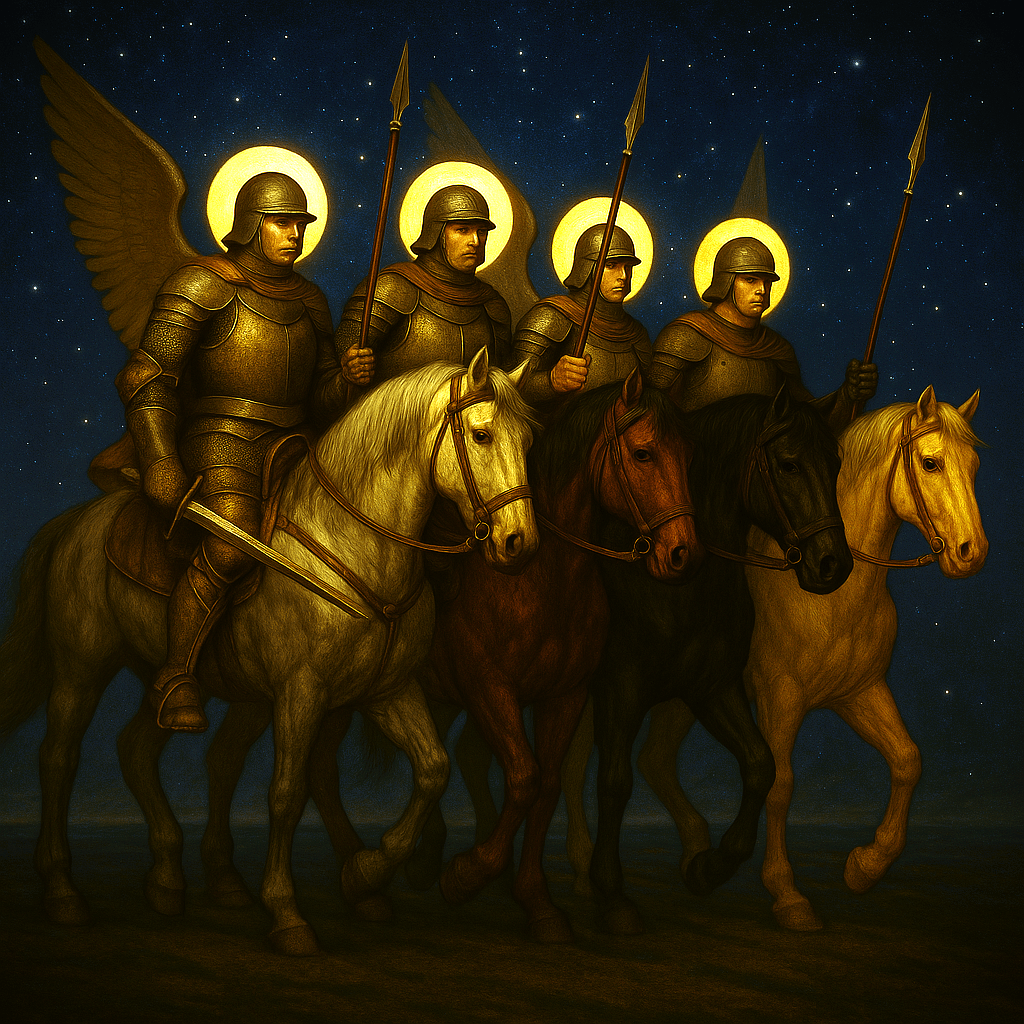
The final vision again presents the patrolling angelic forces from the first vision. In this vision Zechariah is shown four chariots riding out from between two bronze mountains. The horses pulling the chariots are also of various colors just as in the first vision. The interpreting angel describes these chariots as the four spirits of heaven, going forth after presenting themselves before the Lord. They are sent out to patrol the earth where they function as God’s messengers or instruments of God’s judgment. The vision ends with God saying that those angelic forces that proceeded to the land of the north had appeased His wrath there. The image of the chariots displays God’s power and His role as the Divine Warrior in biblical literature.
Interpretation of Visions and Apocalyptic Literature
The following instructions are provided as tools to assist readers in properly interpreting and understanding the vision literature. May it enhance your reading experience.
Interpreting visions is a complex process that has been significant in various religious traditions, particularly in biblical contexts. Visions are supernatural visual manifestations, often accompanied by auditory elements, that serve as divine revelations. In the biblical tradition, visions typically follow a pattern of vision and interpretation, where words are given to explain the meaning of the vision. This pattern is evident in examples such as Pharaoh’s dreams interpreted by Joseph and Nebuchadnezzar’s dreams interpreted by Daniel. The book of Revelation continues this tradition, with John’s account providing both the visions and their interpretations through words. Interpreters of visions often use them as paradigms for later visionaries and mystics, exploring details such as the relationship between new revelations and old covenants. The methodology for interpreting visions can be similar to that used in ancient texts like the Dead Sea Scrolls, where passages are quoted and then explained in relation to contemporary situations. (Peter Adam, Hearing God’s Words: Exploring Biblical Spirituality, ed. D. A. Carson, vol. 16 of New Studies in Biblical Theology (Downers Grove, IL; England: InterVarsity Press; Apollos, 2004), 112).
Apocalyptic literature in the Bible has several characteristics: (1) In apocalyptic literature a person who received God’s truths in visions recorded what he saw. (2) Apocalyptic literature makes extensive use of symbols or signs. (3) Such literature normally gives revelation concerning God’s program for the future of His people Israel. (4) Prose was usually employed in apocalyptic literature, rather than the poetic style which was normal in most prophetic literature.
In addition to Daniel and Revelation, apocalyptic literature is found in Ezekiel 37–48 and Zechariah 1:7–7:8. In interpreting visions, symbols, and signs in apocalyptic literature, one is seldom left to his own ingenuity to discover the truth. In most instances an examination of the context or a comparison with a parallel biblical passage provides the Scriptures’ own interpretation of the visions or the symbols employed. Apocalyptic literature then demands a careful comparison of Scripture with Scripture to arrive at a correct understanding of the revelation being given.
(Pentecost, J. D. (1985). Daniel. In J. F. Walvoord & R. B. Zuck (Eds.), The Bible Knowledge Commentary: An Exposition of the Scriptures (Vol. 1, p. 1323). Victor Books).
 Hosea 4:6 Teaching Ministry
Leave a comment