The Enemy Ahead
As Joshua plots his strategy to enter into the lands of the Canaanites, he analyzes the obstacles that lay ahead. The future nation of Israel is a land of several city-states that are ruled by kings and defended by fierce warriors. He is aware that the war would take several years and would not be successful if it were not for God as their leader and defender. Prior to attacking Jericho, Joshua is met by the Commander of the Lord’s army who assures him that He is with Israel and ensures victory. The war would not be easy, it would span over seven years, and even then, the conquest of the lands would not be complete.
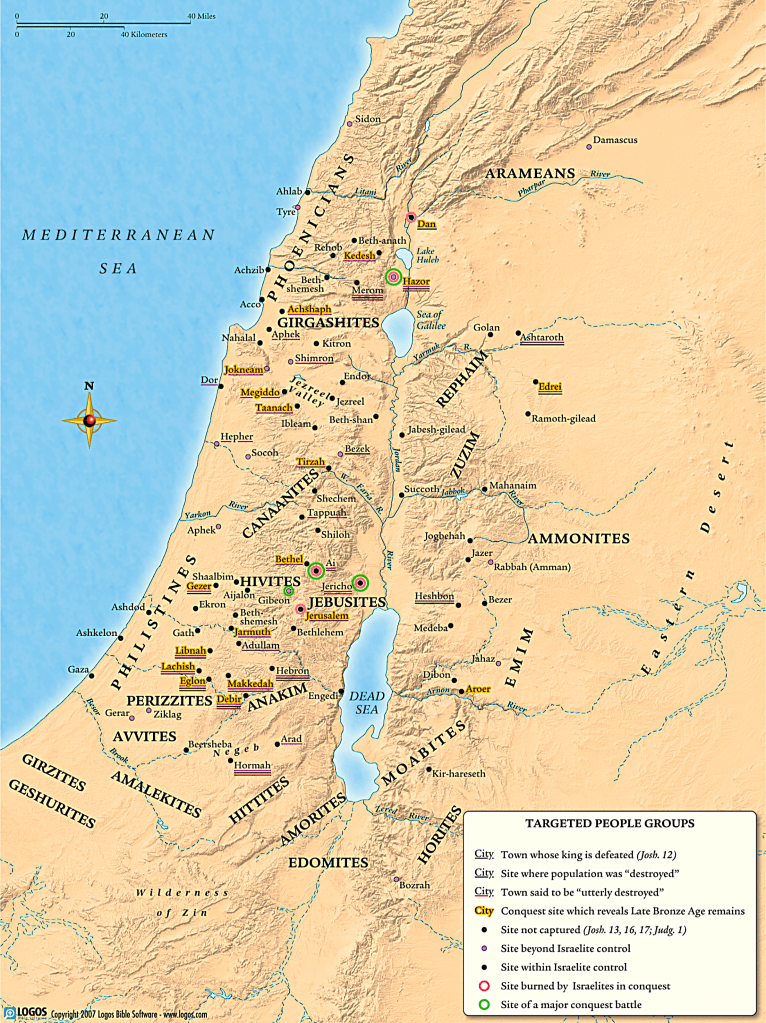
The map above shows the land during the time of Joshua’s command. This is the battleground that lies ahead for Joshua and the Israelites. Jericho and the Canaanites would be the first enemy which would be engaged. Jericho was known for its great fortified walls which protected it from attacks. Many of the enemy groups were known for their brutality and cruelty such as the Amalekites, Midianites, and the Anakim. The Amalekites were especially despised because they did not live by working the land or raising livestock, they survived by raiding other groups and stealing their goods, destroying everything as they left, “So they would camp against them and destroy the produce of the earth as far as Gaza, and leave no sustenance in Israel as well as no sheep, ox, or donkey. For they would come up with their livestock and their tents, they would come in like locusts for number, both they and their camels were innumerable; and they came into the land to devastate it,” (Judges 6:3-15). They also were feared because they targeted the weak and the stragglers who passed through their territories, “Remember what Amalek did to you along the way when you came out from Egypt, how he met you along the way and attacked among you all the stragglers at your rear when you were faint and weary; and he did not fear God,” (Dt. 25:17-19). This is the nature of the enemy and the wicked character of the people that the Israelites would war against. The battles would be brutal, but justice can be seen being administered by God’s hand through the Israelites on cruel and merciless people.
Crossing the Jordan River
After the death of Moses, Joshua is given the order by God to cross the Jordan River, “Moses My servant is dead; now therefore arise, cross this Jordan, you and all this people, to the land which I am giving to them, to the sons of Israel,” (Joshua 1:2). Joshua begins his campaign by sending spies across the river to check the area that they will be moving to, and to enter Jericho to check their defenses. He chose two men as the spies and they entered Jericho, but their presence was discovered, and they sought a place to hide from the guards. They found refuge in the home of a harlot who hid them and misdirected the guards by telling them that they had just left her home. This person was Rahab, who despite being a prostitute would gain much honor for risking her life and for her recognition of the God of Israel by her words:
“I know that the LORD has given you this land and that the terror of you has fallen on us, and everyone who lives in the land is panicking because of you. For we have heard how the LORD dried up the water of the Red Sea before you when you came out of Egypt, and what you did to Sihon and Og, the two Amorite kings you completely destroyed across the Jordan. When we heard this, we lost heart, and everyone’s courage failed because of you, for the LORD your God is God in heaven above and on earth below.”
The spies promised to save Rahab and her family from the coming destruction in return for her cooperation and acknowledgement of their God. They returned to their camp and gave their report to Joshua in which they revealed that the people of Jericho greatly feared them because of their victories and of their God. They were confident that God had surely given them victory.
Note on Rahab–
Rahab is an interesting character that is often overlooked but is mentioned favorably in the Scriptures. She was a sinful pagan who acknowledged God as the one true God. She repented and became a convert to Yahweh by joining the Israelite people. The Scriptures refer to the great faith of Rahab who was delivered from destruction by God. She is listed in the book of Hebrews and James as an example of a person with great faith. She is also listed in the genealogy of Jesus in the gospel of Matthew. She would marry Salmon, a prince of the tribe of Judah, and give birth to Boaz. Boaz would marry Ruth, the Moabite(another foreigner), who would be the mother of Obed. Obed was the father of Jesse, and Jesse was the father of King David–From the line of King David would come Jesus, the Messiah. Rahab, the sinful prostitute, would receive God’s mercy and grace because of her faith in the one true God and her repentance. She was a foreigner that was welcomed into the family of God, and she was used as an instrument in God’s plan of salvation because of her loyalty. She is a model of God’s mercy, grace, and forgiveness for all people. In this same tradition, Jesus ministered to the outcasts of society, the poor, lame, lepers, Gentiles, prostitutes, tax-collectors, and sinners, “When the Pharisees saw this, they said to His disciples, “Why is your Teacher eating with the tax collectors and sinners?” But when Jesus heard this, He said, “It is not those who are healthy who need a physician, but those who are sick. “But go and learn what this means: ‘I DESIRE COMPASSION, AND NOT SACRIFICE,’ for I did not come to call the righteous, but sinners,” (Matt. 9:11-13).
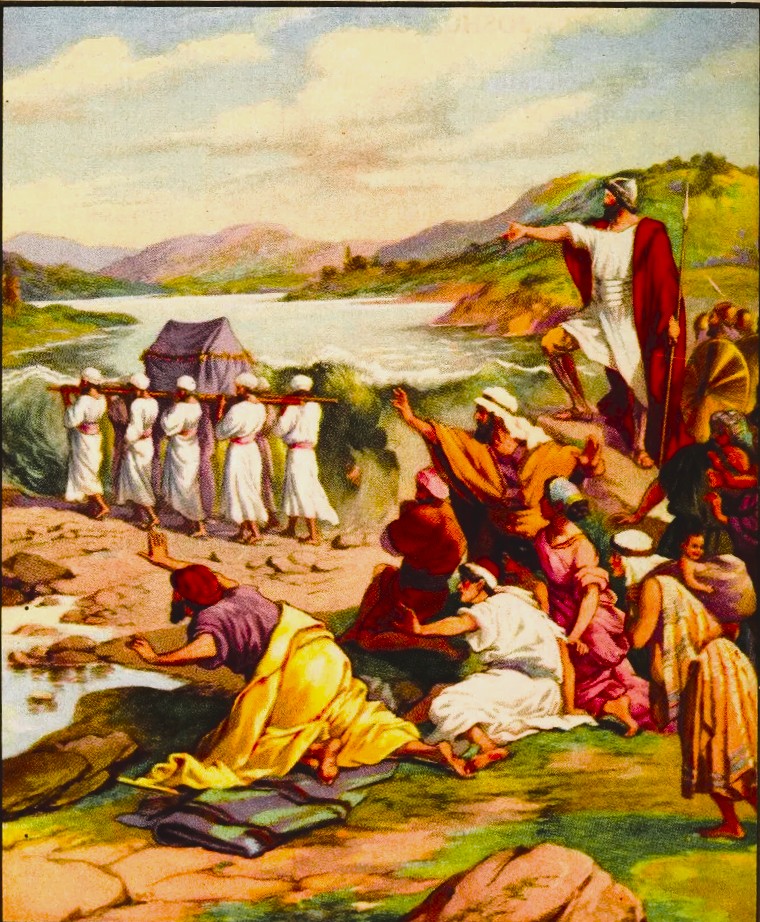
And the priests who carried the ark of the covenant of the LORD stood firm on dry ground in the middle of the Jordan while all Israel crossed on dry ground, until all the nation had finished crossing the Jordan. (Josh. 3:17)
Joshua ordered the people to move the camp to the bank of the river where they stayed for three days until God instructed Joshua on how they were to cross. The following day Joshua commanded the priests to carry the ark of the covenant and enter into the river ahead of all the people. As the priests entered the river, the waters stopped flowing and the riverbed was dry as the people crossed. This miracle was a repeat of the miracle of the crossing of the Red Sea when God divided the waters there so that the Israelites could cross safely. After crossing they camped at Gilgal on the plains of Jericho preparing for the invasion of the city. The news of the miraculous crossing of the Jordan by the Israelites reached all the Amorite and Canaanite kings causing them to panic and lose all confidence.
Joshua and the Angel of the Lord
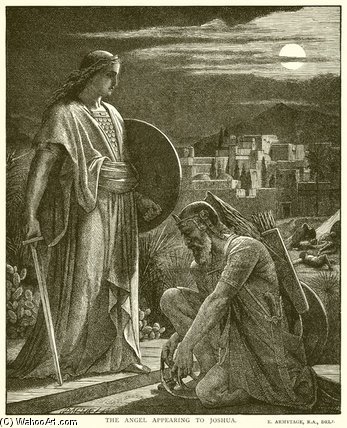
Joshua is confronted by the Commander of the Lord’s army.
“And it came to pass, when Joshua was by Jericho, that he lifted his eyes and looked, and behold, a Man stood opposite him with His sword drawn in His hand. And Joshua went to Him and said to Him, “Are You for us or for our adversaries?” So He said, “No, but as Commander of the army of the LORD I have now come.” And Joshua fell on his face to the earth and worshiped, and said to Him, “What does my Lord say to His servant?” (Joshua 5:13-14)
After they had crossed and made camp on the other side of the river, Joshua was suddenly confronted by a mighty warrior with a sword in His hand. Joshua was at first puzzled at who this person was as he did not recognize Him as a Canaanite enemy. Joshua challenged Him by asking, “Are you for us or for our enemy?” The warrior responded by saying that He was for neither, He had come as the Commander of the Lord’s Army. Joshua immediately recognized this title as meaning that He was the Lord God by falling to the ground, bowing down, and saying, “What has my Lord to say to his servant?” The warrior verifies His deity by commanding Joshua to remove his sandals because the ground on which he was standing was holy. This was the same instruction given by God to Moses at the burning bush on Mt. Horeb, (Ex. 3:4-5). The Lord then assures him that He has given him victory over Jericho and gives Joshua instructions for the battle.
Battle of Jericho
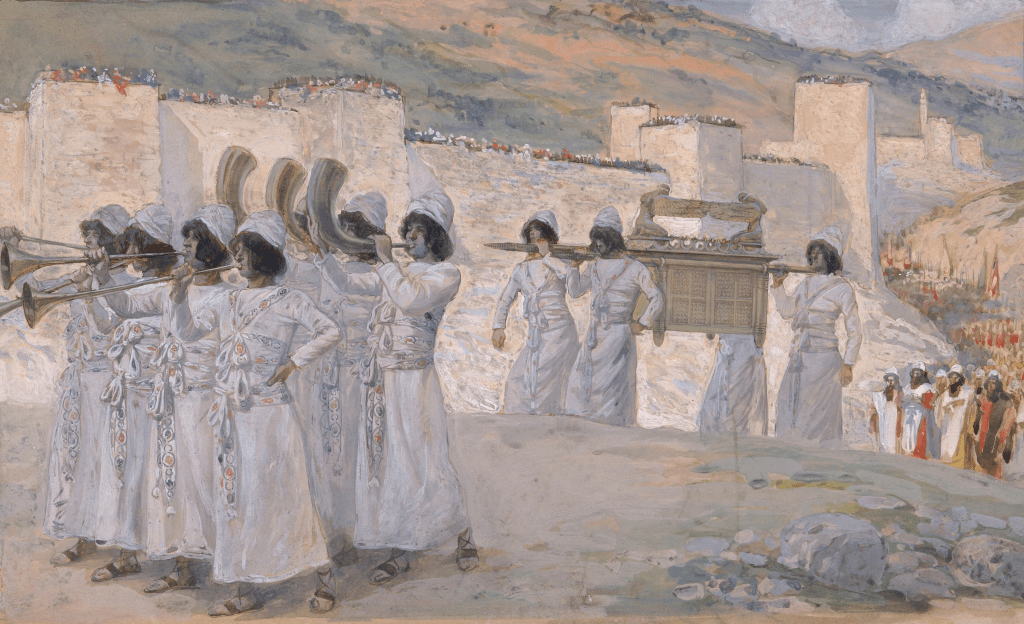
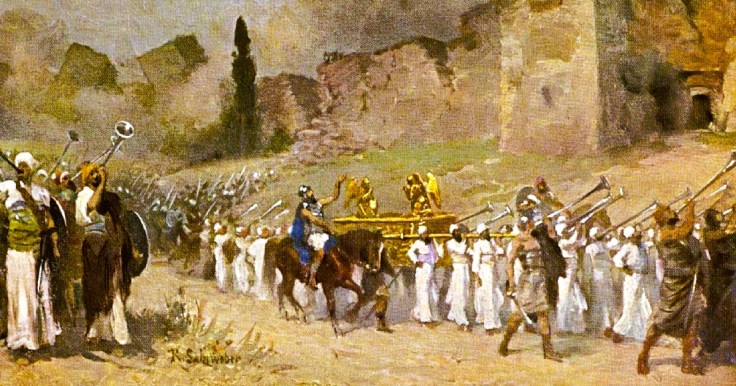
The above quote contains the instructions given by the Lord to Joshua for the assault on Jericho. The battle for Jericho would not be easy because they possessed a powerful army and their fortress had been impenetrable. But they had the Lord’s promise, and the Canaanites were filled with fear after witnessing the miracle of the crossing at Jericho. The stage was set and Joshua prepared the people for battle. He gave the instructions to the priests and the army, and the battle began. On the first day they circled the city once with the priests carrying the ark of the covenant and blowing the trumpets. Joshua ordered that they were not to shout or say a word until He gave the command. They repeated this routine for a total of six days. On the seventh day before the march, Joshua warned the army that nothing is to be taken from the city for personal spoils of war, all items of value were to be placed in the treasury of the Lord. (This command would have severe consequences in the next battle). The army and the priests marched around the city seven times blowing the trumpets with the added shouts of the people, and the walls of the city fell down flat. The army attacked, destroying everything and everyone in the city except Rahab and her family who were spared from the destruction according to the vow given to her by the spies. The city was burned and the items of gold, silver, bronze, and iron were placed in the Lord’s treasury. Israel achieved its victory just as promised by the Commander of the Lord’s army, and the fame of Joshua spread throughout the land.
The Battle for Ai
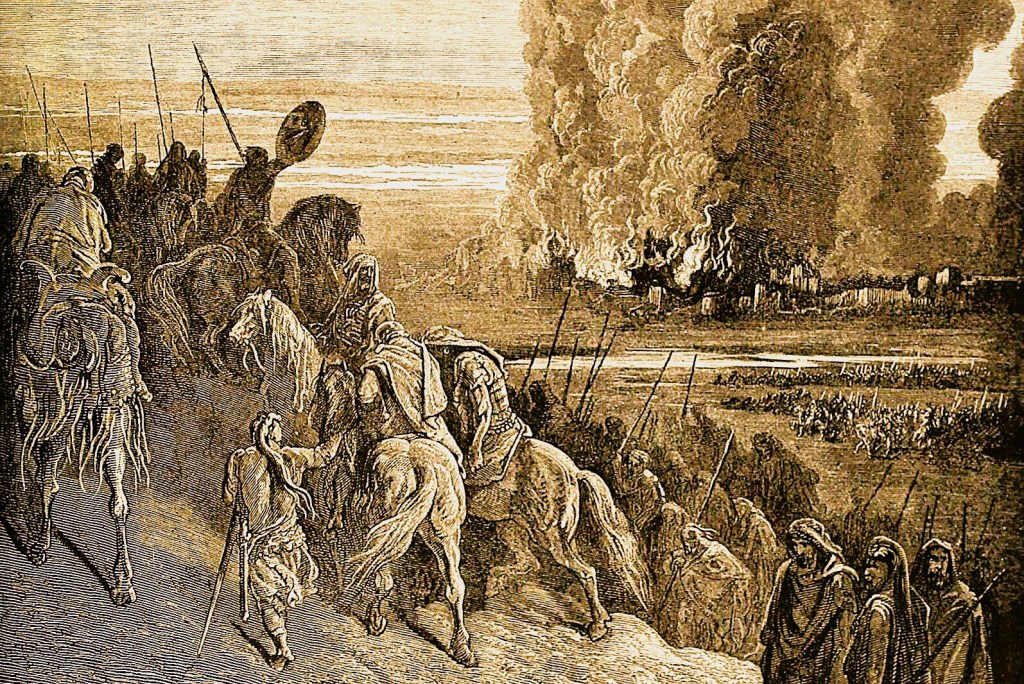
The Israelites were riding high after the victory at Jericho, and they were feeling confident, (maybe a little too confident), as they marched on toward Ai. After checking on the defenses of the city and considering their recent great success they determined that they would only need a small force of to overcome it. Three thousand men attacked Ai, but they were quickly repelled by the opposing force and 36 of their men were killed by the enemy. They lost courage and retreated back to their camp in humiliation. Joshua and all the elders of the city mourned and fell to the ground in sorrow knowing that the Lord was not with them. Joshua prayed to God and He quickly answered with a serious rebuke. The Lord advised Joshua that the people had sinned and violated His covenant by keeping things that had been taken from Jericho that were supposed to be placed in the Lord’s treasury. In effect, they had stolen what belonged to God. Therefore, God would no longer be with them until redemption was made. An investigation is made with divine assistance, and it is discovered that a person named Achan had taken and kept silver coins, a gold bar, and a luxurious cloak. The items were found buried in his tent and they were destroyed because the Lord considered them accursed. Achan, and all of his family members were taken outside of the camp and stoned to death. They along with the stolen items were then burned with fire and buried.
After God’s wrath had been appeased, the Lord consoled Joshua by assuring him that He is still with Israel and they should not fear the army of Ai because He had given the city over to his hand. God instructed Joshua to set an ambush with a sizable force of five thousand at the rear of the city. Joshua and the main force approached the front part of the city. The king of Ai and his army saw the Israelites and went out to attack them. The king took his entire force out to engage the Israelites believing that they would have the same result that they had achieved a few days earlier, but unknown to him there was an ambush set behind them. As the army of Ai approached the Israelites, Joshua and his army turned and began retreating as if they had been beaten. When all of the soldiers of Ai were out of the city and no defenders were left in it, Joshua stopped and gave the signal to the ambushing force. They came out of their hiding place and entered the city, burning it in their assault. The army of Ai stopped and looked back when they saw that their city was on fire. The Israelites turned around and attacked the army of Ai from the front while the ambushing force came out of the city and attacked them from the rear. The army of Ai who thought that they were the pursuers were now caught in the middle of the ambush and trapped as they had no place of retreat. The Israelites cut them all down leaving none alive except for the king who was captured. Unfortunately, the king was taken to a nearby tree and hanged. As for the city of Ai, it was totally destroyed and burned to the ground making it uninhabitable. The details of the conquests may sound harsh according to our 21st century western sensibilities, but these were barbaric people who committed horrific acts of evil for which God is distributing His punishment. Remember God’s instruction to Moses regarding the possession of the “Promised Land,” “Only in the cities of these peoples that the LORD your God is giving you as an inheritance, you shall not leave alive anything that breathes. “But you shall utterly destroy them, the Hittite and the Amorite, the Canaanite and the Perizzite, the Hivite and the Jebusite, as the LORD your God has commanded you,” (Deut. 20:16-17).
 Hosea 4:6 Teaching Ministry