The Northern Alliance
After the Israelites had crushed the open resistance of southern Palestine, the cities of the north formed a league against them under Jabin, king of their head city of Hazor. These soldiers of the north fought in chariots, charging with their horses across the open plains; and hence the Israelites, accustomed only to fighting upon foot, held these new enemies in dread. God once more encouraged Joshua with assurance of His aid; and again Joshua arranged a sudden attack, rushing upon Jabin’s camp, while the horses and chariots were unready.
(Horne, Charles, and Julius Bewer. The Bible and Its Story: The History, Vol. 3.)
As Joshua and the Israelites marched northwards to complete their conquest, the kings of the northern kingdoms grouped together to form their own coalition force just as the southern kings did. Hazor was the major power in the north and their king, Jabin, called the other kings together to oppose Israel. Joining Hazor were Jobab the king of Madon, the kings of the cities of Shimron, and Achshaph, the kings of northern hill country, the plain south of the Sea of Galilee, the lowland, and the heights of Dor. This coalition brought together six people groups who were usually at odds with one another–the Canaanites, Amorites, Hittites, Perizzites, Jebusites, and the Hivites. This combined force was massive, described in Scripture as, “many people as the sand on the seashore, with very many horses and chariots,” (Josh.11:4). This added new challenges for Joshua and his army. They would face a greater force than ever before, and they would encounter superior weaponry and tactics in the form of chariot warfare. Despite these obstacles, the Israelites had one superior advantage, their God was with them. Vastly outnumbered, they remained fearless as they advanced toward this vast enemy.
The Battle at Merom
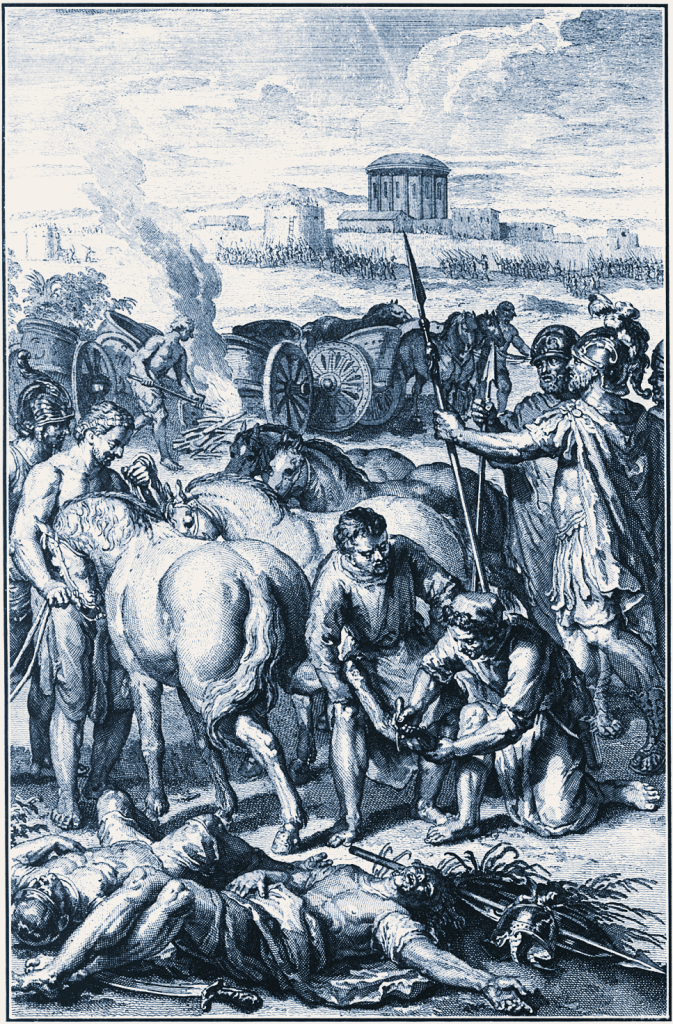
The great force of the northern alliance came together by the waters of Merom and camped there ready to engage the Israelite force. The Lord again encouraged Joshua with the promise of victory and with some instructions for the battle. He instructed Joshua to hamstring the enemies’ horses and to burn their chariots. Joshua brought his army to the enemy camp and swiftly attacked them with great force. The Israelites did as God commanded and disabled their horses and set their chariots on fire. The enemy scattered in various directions and were struck down as they fled. Joshua and the army pursued and destroyed them all as the Lord delivered them into their hands.
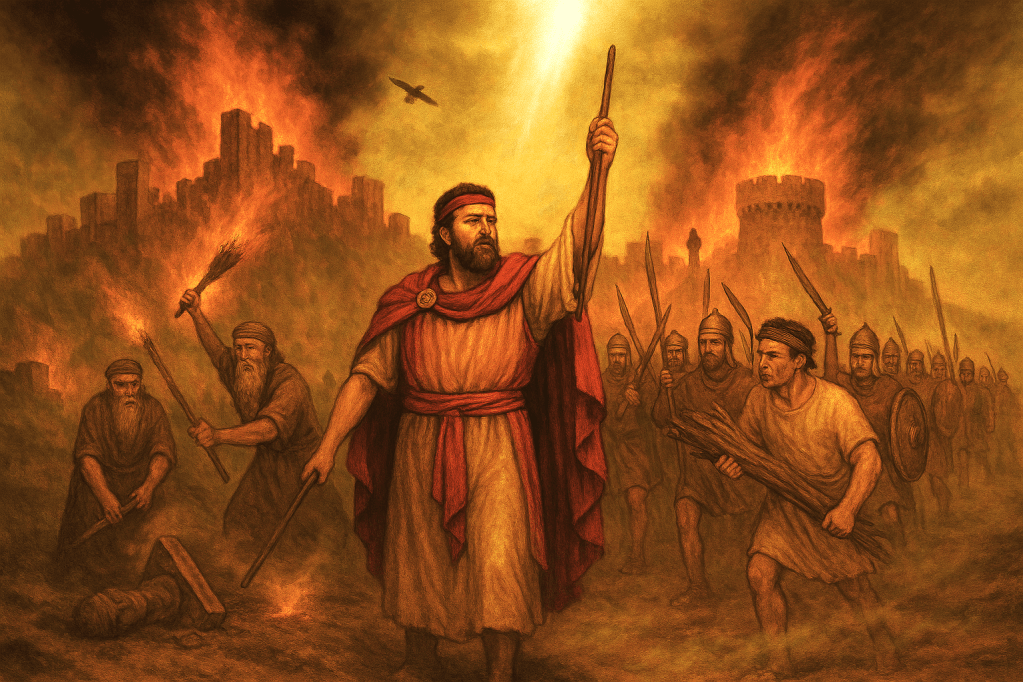
The Israelites followed King Jabin as he fled to Hazor where they captured and killed him. They attacked the city and struck down all of its inhabitants. Joshua then burned the city because it was the head of the northern kingdom. No other northern city was burned. Joshua continued his campaign in the north for “a long time with all these kings,” as described in Scripture, (Josh.11:18). Joshua and the Israelites conquered and destroyed all the cities of the northern hill country, the lowlands, the plain of the Sea of Galilee, and all the other cities of the northern kingdom. The final enemy to be conquered were the Anakim in hill country around Hebron and Debir.
Joshua and His Army Destroy the Anakim
The Anakim
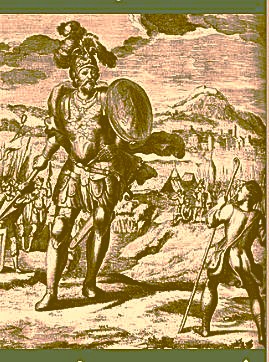
The Anakim were ancestors of a race of giants who lived in the coastal and hill country around Hebron. They are the descendants of Anak, said to be the greatest of these giants who were greatly feared for their great size and strength. The prophet Amos referred to them as “tall as cedars and strong as the oaks,” (Amos 2:9). Goliath is an example of the Anakim giants.
The Anakim were great warriors that brought fear to any foe that opposed them due to their great size and strength. These giants lived in areas throughout Canaan and were known by different names according to the different people groups of the region. They were known as the Rephaim in the territory of the Ammonites, who also called them Zamzummites. The giants who lived in Moab were called the Emmim. Another name associated with the Anakim is Nephillim. Among this group of giants were King Og of Bashan and Goliath the Philistine slain by King David. Both of these giants were estimated to be nine feet tall. The Anakim were eliminated and removed from the conquered areas by Joshua and Caleb during the conquests. A few survived and moved to other areas such as the Philistine areas of Gath and Ashdod where they would resurface later to oppose the Israelites during the reigns of King Saul and King David. They persisted until the reign of King David who eradicated the last of their kind, as there are no further accounts of them recorded in Scripture.
The last conflicts in Joshua’s conquest are against the Anakim, who put such fear in the people when they first scouted the promised land that they rebelled against God. Now, under the leadership of Joshua and secure in the power of God, they attacked them with great courage. These remaining territories and their people were completely destroyed just as the others had been. The Anakim according to Joshua 11:22 no longer were in the land, but some remained only in Gaza, Gath, and Ashdod.
The Campaign Ends
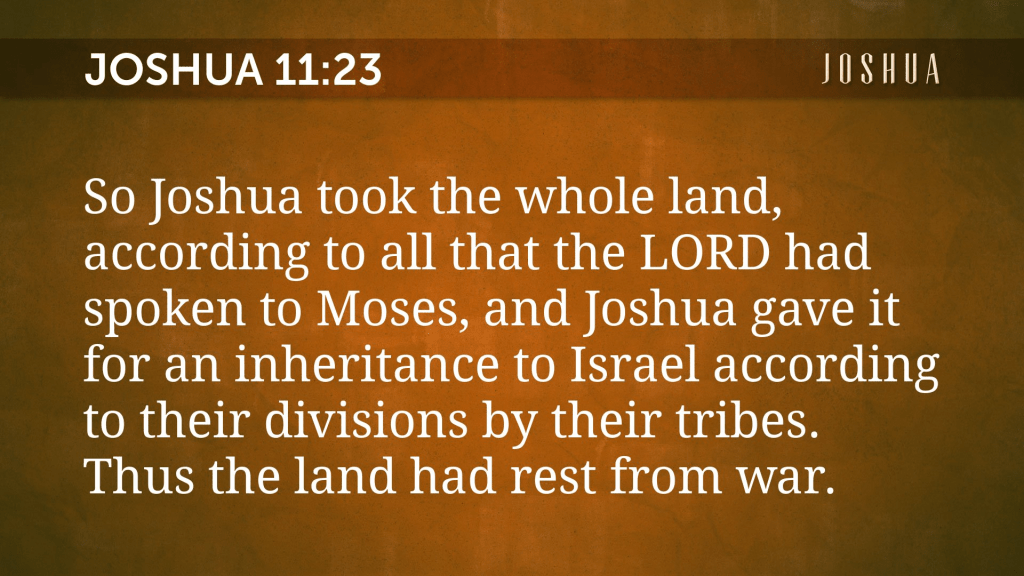
With the victory over the Anakim, the conquest campaign of Joshua comes to an end. As the final verse of chapter 11 records, “Thus the land had rest from the war.” Joshua’s campaign and the war to secure the promised land given to them by God lasted around seven years. In this time Joshua and the Israelites were tested by their faith and by their courage. They went up against a much greater enemy which they originally feared. They feared the Canaanites so much that they rebelled against God, attempted to kill Joshua and Caleb, and pleaded to go back to Egypt. After their 40 years of wondering in the wilderness, and just before they are to enter the promised land, Moses prepared them by reminding them of their lack of faith and their fear which caused them to delay this moment by 40 years. In the passage below we see the image of a fearful and rebellious people–And now that the campaign is over and there is rest from war, we can see the contrast in a people who are courageous conquerors and who fully trust in their Lord.
“Yet you were not willing to go up, but rebelled against the command of the LORD your God; and you grumbled in your tents and said, ‘Because the LORD hates us, He has brought us out of the land of Egypt to deliver us into the hand of the Amorites to destroy us. ‘Where can we go up? Our brethren have made our hearts melt, saying, “The people are bigger and taller than we; the cities are large and fortified to heaven. And besides, we saw the sons of the Anakim there.” ’ “Then I said to you, ‘Do not be shocked, nor fear them. ‘The LORD your God who goes before you will Himself fight on your behalf, just as He did for you in Egypt before your eyes, and in the wilderness where you saw how the LORD your God carried you, just as a man carries his son, in all the way which you have walked until you came to this place.’ “But for all this, you did not trust the LORD your God,“
Deut. 1:26-32
 Hosea 4:6 Teaching Ministry