
Introduction
Ezekiel was a prophet chosen by God to minister to the Israelites who had been exiled to Babylon, and to warn them of impending judgment on Jerusalem because of the people’s idolatry and wickedness. He was a priest who was born in Jerusalem and taken captive by the Babylonians in 597 BC. Five years later at the age of 30 he was called to minister to the Israelite captives in Babylon. Ezekiel was given strange and interesting visions concerning the coming destruction of Jerusalem and God’s plans for the restoration of Israel. The theme of the book of Ezekiel is, “the knowledge of God.” In God’s revelation to Ezekiel the phrase, “Then they will know that I am Yahweh(God),” is used 65 times. This knowledge is expressed throughout the book as God presents His judgments, explains the reasons for the judgments, and then justifies His decisions. An example is in the 9th chapter, God gives His judgment where every person in the city who does not protest against the idolatry and wickedness is to be killed. Women and children are included in this slaughter which causes Ezekiel to strongly object. The Lord responds by saying, “The iniquity of the house of Israel and Judah is very, very great, and the land is filled with blood and the city is full of perversion; for they say, ‘The LORD has forsaken the land, and the LORD does not see!’ “But as for Me, My eye will have no pity nor will I spare, but I will bring their conduct upon their heads,” (Ezek. 9:9-10). He adds further justification in chap. 11, “Thus you will know that I am the LORD; for you have not walked in My statutes nor have you executed My ordinances, but have acted according to the ordinances of the nations around you,” (Ezek. 11:12). In passages such as this, God’s wrath and justice are revealed through His judgment, and He gives His rationale by which we gain a healthy fear of the powerful and almighty God. Many Christians tend to downplay God’s wrath and focus only on His love. Proper knowledge of God is to understand Him as He is expressed in all of His attributes. In other words, God’s “love” is balanced by His “justice.” His wrath is brought forth through His judgments on the wicked and disobedient. A basic knowledge of Scripture reveals that God’s judgments did not end in the Old Testament, His greatest judgment and wrath is yet to come as revealed in the book of Revelation. For believers, God’s wrath has been satisfied by the sacrifice of Christ, and they are at peace with Him. For unbelievers, they are enemies of God because of their unredeemed sin and rejection of His son which will bring God’s wrath down upon their heads. Reading the Book of Ezekiel with its revelation of God’s thoughts concerning His judgments and wrath should bring comfort to the believer, and absolute terror to the unbeliever.
The visions witnessed by the prophet Ezekiel are among the most colorful, frightening, and interesting. Some of them, such as the Four Living Beasts push the mind to its limits as it tries to comprehend the imagery. Just like the visions of Zechariah, the visions of Ezekiel provide a glimpse behind the veil that separates the physical world and the spiritual world. These visions often presented physical images of spiritual realities that the prophets struggled to explain. The reader is advised to read the description of the visions slowly and to read them repeatedly in order to grasp the images presented.
Background Information
Ezekiel is given numerous prophecies including visions which pertain to the situation concerning Israel and the people during his time. Some background information is necessary in order to understand the significance of the visions and the meaning of the prophecies. The nation of Israel was divided into two separate nations after the reign of King Solomon. The people reverted to the worship of pagan idols, and they engaged in wicked conduct in violation of the Mosaic law and covenant. God, through several prophets warned them of impending judgment if they did not repent. They ignored the warnings, and the ten tribes of the Northern Kingdom were captured by the Assyrians and taken into exile in 722 BC. Judah, the Southern Kingdom, was also given warning to repent by prophets or they would suffer the same fate. They continued their disobedience and were conquered by the Babylonians in 586 BC. Jerusalem and the temple were also destroyed. The prophets Jeremiah, Daniel, and Ezekiel were called to minister to the people during this time. Jeremiah was the first and he prophesized in Jerusalem before and during the conquest. He remained in Jerusalem and was not taken by the Babylonians. The exile of the Israelites occurred in three stages, with Daniel taken in the first, and Ezekiel taken in the second. Daniel ministered to the exiles who were part of the king’s court in Babylon. Ezekiel ministered to the exiles who lived in a town sixty miles southeast of Babylon. His messages to the Babylonian exiles served three purposes: to justify God’s purpose in punishing the Israelites, to pronounce punishment on the nations surrounding Israel for their abuse, and to encourage the exiles for coming restoration and blessings. This teaching will concentrate on two of Ezekiel’s visions; the Vision of the Four Living Beasts, and the Vision of God’s Glory. These visions, in my opinion, are among the most fascinating found in Scripture and these same visions will be seen by other prophets such as Isaiah and the Apostle John in Revelation.
Vision of the Four Living Beasts
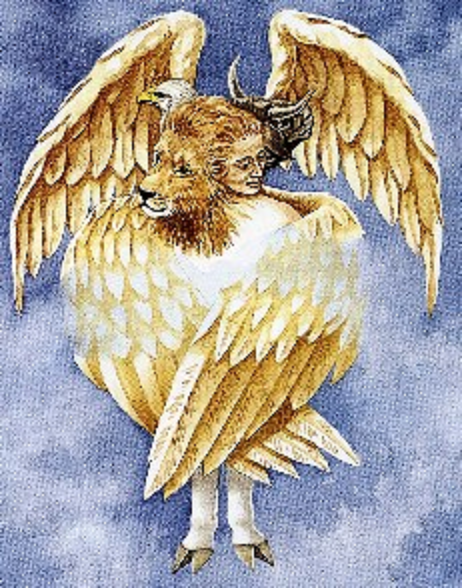
As I looked, behold, a storm wind was coming from the north, a great cloud with fire flashing forth continually and a bright light around it, and in its midst something like glowing metal in the midst of the fire. Within it there were figures resembling four living beings. And this was their appearance: they had human form. Each of them had four faces and four wings. Their legs were straight and their feet were like a calf’s hoof, and they gleamed like burnished bronze. (Ezek. 1:4-6)
The prophet Ezekiel is suddenly given a vision as he was resting along the Chebar river in Babylon. He was given a view of God’s heavenly throne room which contained four-living beings who serve constantly alongside God’s presence protecting His holiness and His sacred space. Ezekiel is awestruck with the magnificence of the heavenly throne room and is limited by human language in trying to explain spiritual realities. His attention must have first been drawn to the four-heavenly creatures as they are very strange and mysterious looking. He describes them as having a human form but also with animal type features, and they moved back and forth like bolts of lightning.
“Within it there were figures resembling four living beings. And this was their appearance: they had human form.
Each of them had four faces and four wings.
Their legs were straight and their feet were like a calf’s hoof, and they gleamed like burnished bronze.
Under their wings on their four sides were human hands. As for the faces and wings of the four of them,
their wings touched one another; their faces did not turn when they moved, each went straight forward.
As for the form of their faces, each had the face of a man; all four had the face of a lion on the right and the face of a bull on the left, and all four had the face of an eagle.
Such were their faces. Their wings were spread out above; each had two touching another being, and two covering their bodies.” (Ezek. 1:5-11)
To help process the description of these creatures it is necessary to examine Ezekiel’s description step-by-step and feature-by-feature. Ezekiel is describing an angelic type of creature that appears human in appearance. It has straight legs, not curved liked an animal, and feet shaped like a calf’s hoof. Their legs and feet shined like polished bronze. They each had four wings. Two of the wings were spread out above them and the other two wings were spread below to cover their bodies. They possess human hands which are kept under their wings. Each creature had four different faces on their heads. In front they had a face of a man, on the right side a face of a lion, on the left side the face of an ox, and the face of an eagle on the back. I’m sure the sight of this creature both mystified and terrified Ezekiel. Scholars through the ages have been unable to determine if this was an actual image of the creature or a symbolic image where aspects of the creature’s attributes are emphasized for Ezekiel’s understanding. For example, the faces are believed to have special significance. The human face signifies man as the crown of God’s creation. The lion is the king of beasts which signifies strength and courage The ox is revered as the pride of the beasts of burden signifying servanthood. Finally, the eagle is known as the king of the birds, and he signifies swiftness and sharp eyesight. The four-heavenly creatures have received these great attributes because they are given dominion around God’s throne as they are stationed below it. “Now over the heads of the living beings there was something like an expanse, like the awesome gleam of crystal, spread out over their heads.” “Now above the expanse that was over their heads there was something resembling a throne, like lapis lazuli in appearance; and on that which resembled a throne, high up, was a figure with the appearance of a man,” (Ezek. 1:24&26).
These angelic creatures are also known as cherubim. Cherubim are winged angelic creatures that surround the throne of God and are constantly providing praise and worship to Him. Images of the cherubim were placed in holy places such as the Tabernacle, the Ark of the Covenant, and in the Most Holy Place of Solomon’s temple. After the Fall, when Adam and Eve were evicted from the Garden of Eden, cherubim were stationed at the entrance to guard the garden. In each of these instances the cherubim act as guardians of holy and sacred space. Ezekiel’s prophetic ministry was intended to provide the people with “the knowledge of God,” so that they would repent and to return to Him as His possession. The vision of the four-living beings and God’s throne room provides a glimpse of God’s glory, majesty, and power. It is also the seat of God’s rule and reign over all creation and the vision expresses God’s sovereignty where He alone is God, and He will not tolerate the worship of false gods.
Vision of Idolatry and Defilement of the Temple

A reading of Ezekiel chapters eight and nine will most likely shock most readers as they experience the wicked idolatry that was being committed in God’s holy temple. Idolatry was a common evil that plagued the ancient Israelites as they constantly rebelled against God, but the idolatry practiced in the temple was on a different level as it moved beyond rebellion to outright hatred and treachery against the God that delivered and protected them. The words used by God to describe this idolatry is “wicked abominations.” Abomination is a term which is used in Scripture to describe something that causes great hatred and disgust. This vision is most interesting as it shows the depravity of the priests as they engage in these abominations which produces God’s anger and disgust with them, and He unleashes His wrath down upon them.
Before we begin to interpret this vision, there are a few points to remember which will help to lay out the scenario that is taking place. Ezekiel received this vision in 592 BC after he had been in Babylon for five years and had no knowledge of the events occurring in Jerusalem, especially in regard to the temple. This vision that is shown to him depicts the actual events occurring at that time and also depict the coming destruction of the temple and the people in 586 BC. Ezekiel is sitting in his house with a group of elders when he is suddenly taken by the Spirit of God to the temple in Jerusalem.
“It came about in the sixth year, on the fifth day of the sixth month, as I was sitting in my house with the elders of Judah sitting before me, that the hand of the Lord GOD fell on me there. Then I looked, and behold, a likeness as the appearance of a man; from His loins and downward there was the appearance of fire, and from His loins and upward the appearance of brightness, like the appearance of glowing metal. He stretched out the form of a hand and caught me by a lock of my head; and the Spirit lifted me up between earth and heaven and brought me in the visions of God to Jerusalem, to the entrance of the north gate of the inner court, where the seat of the idol of jealousy, which provokes to jealousy, was located.” (Ezek.8:1-3).
God then takes Ezekiel on a guided tour through the temple to show him the wicked idolatry that is taking place in His holy temple. As God begins the tour, He gives Ezekiel the following preparatory statement, “And He said to me, “Son of man, do you see what they are doing, the great abominations which the house of Israel are committing here, so that I would be far from My sanctuary? But yet you will see still greater abominations,” (Ezek. 8:6). Ezekiel will be shown three more instances of the idolatry that is taking place in the temple before he is shown the judgment that will fall upon Jerusalem in the Babylonian destruction that will occur only a few years later.
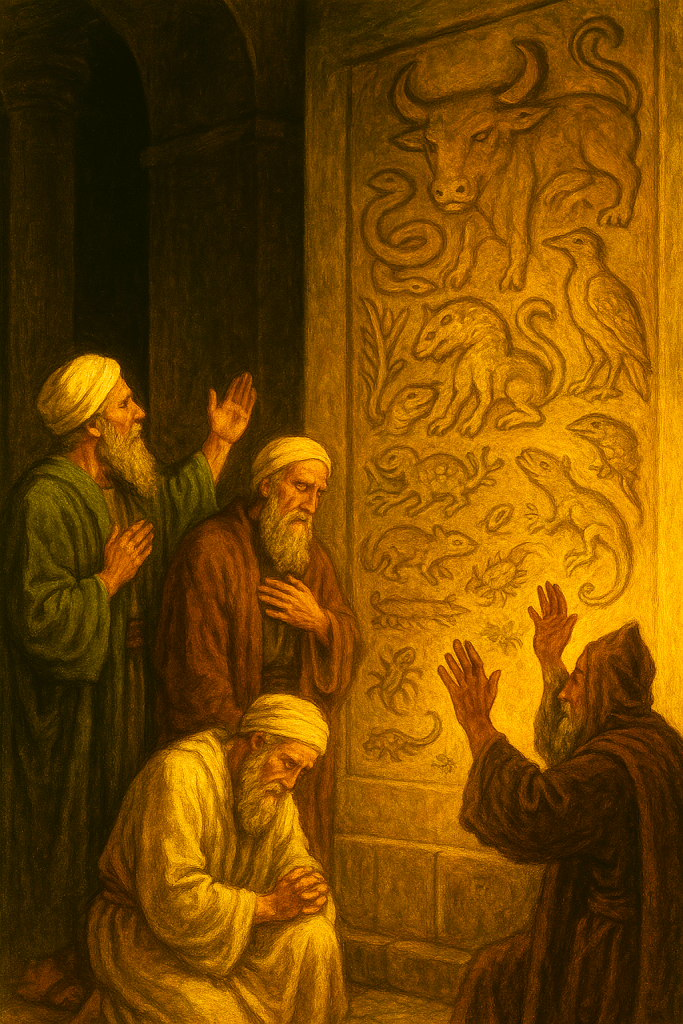
In the first scene, Ezekiel is ordered to dig through a wall of the temple court and into an inner room where he sees that the walls are covered with carvings of idolatrous images of reptiles, beasts, and other detestable things. He then sees the seventy elders of the house of Israel holding an incense burner as they worshipped these carved images. God responds to this scene by informing Ezekiel that the elders commit these abominations because they say, “The Lord does not see us; the Lord has forsaken the land.”
The second act of idolatry that is shown to Ezekiel involves a group of women who are sitting at the gate of the temple weeping for the false god, Tammuz. Tammuz is the ancient Mesopotamian god of fertility.
Ezekiel is then taken into the inner court of the temple where he is shown the third act of idolatry involving twenty-five men who have placed their backs to the temple and are lying flat on the ground as they face the sun to worship it.
God declares that the people have provoked His wrath through their abominations which they have committed in the house of the Lord. He signals His intentions with the following statement, “Therefore, I indeed will deal in wrath. My eye will have no pity nor will I spare; and though they cry in My ears with a loud voice, yet I will not listen to them,” (Ezek. 8:18). In the next chapter, God reveals His judgment where the people are to be slain for their wicked idolatry which has defiled the temple and rendered it unclean. Those who detested and grieved over the abominations were to receive a mark on their foreheads indicating that they are to be spared from the impending slaughter. In the vision, the slaughter is carried out by six angels of execution who go throughout the city striking down anyone who does not have the mark of safety on their forehead. God’s wrath is severe as this judgment was carried out six years later by the Babylonian conquerors. Ezekiel was chosen to be a witness to the wickedness that brought the destruction of Jerusalem and the temple. He recorded this vision in his prophecies which he gave to the elders of Judah and the other exiles in Babylon. Six months after the destruction of Jerusalem, Ezekiel receives the news, “Now in the twelfth year of our exile, on the fifth of the tenth month, the refugees from Jerusalem came to me, saying, “The city has been taken,” (Ezek. 33:21).

“But as for those whose hearts go after their detestable things and abominations, I will bring their conduct down on their heads,” declares the Lord GOD,” (Ezek. 11:21).
God’s Glory
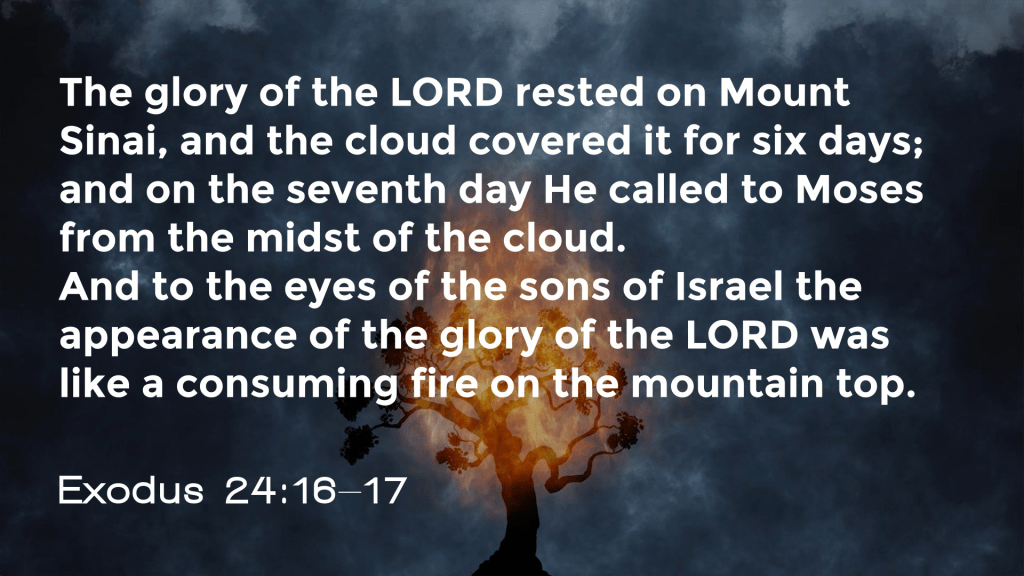
An important aspect of this vision that is that Ezekiel is shown the Throne Room of God, including the Glory of the Lord, “As the appearance of the rainbow in the clouds on a rainy day, so was the appearance of the surrounding radiance. Such was the appearance of the likeness of the glory of the LORD. And when I saw it, I fell on my face and heard a voice speaking,” (Ezek. 1:28). Only a few of the prophets were granted this vision; Isaiah, Daniel, Ezekiel, and the Apostle John–And the descriptions of their visions are quite similar, which adds credibility to the view that they were all shown the same scene. The Throne Room of God will be the subject of a future article; the Glory of God is the focus here. In the book of Exodus, the glory of the Lord is displayed on Mt. Sinai in the form of smoke, fire, thunder, lightning, and a thick cloud. There was also a very loud trumpet sound which shook the whole mountain and frightened the people down below. Only Moses, Aaron and a few elders were allowed to approach the mountain.

The people were warned to stay off the mountain or they would be destroyed. God’s manifested presence, (not a vision), included His power and holiness which brought fear and trembling to all those who were witness to it.
After Moses and the workers completed building the tabernacle, the glory of the Lord filled it, and He resided with His people. “Then the cloud covered the tent of meeting, and the glory of the LORD filled the tabernacle. Moses was not able to enter the tent of meeting because the cloud had settled on it, and the glory of the LORD filled the tabernacle,” (Exodus 40:34-35). These are the roots of God’s glory dwelling with His people and providing them comfort, protection, and blessings in accordance with His covenant with them.
God’s glory can be defined as God’s visible manifested presence. This visible presence is often in the form of fire, smoke, and a cloud. God’s glory is also manifested in the form of a bright light or burning fire such as the “burning bush“, or as Jesus revealed His glory in the transfiguration, “And He was transfigured before them; and His face shone like the sun, and His garments became as white as light,”(Matt. 17:2). In the New Testament, God’s glory is now manifested in the person of Jesus Christ as He is the visible image of the Father, (Col 1:15). The following citation from the Lexham Survey of Theology provides greater understanding of the glory of God.
“God’s glory is the manifestation of the perfection of all of his attributes. The doctrine of the glory of God emphasizes his greatness and transcendence, his splendor and holiness. God is said in Scripture to be clothed with glory and majesty. God’s glory filled the places that he subsequently designated as meeting places with his people: the tabernacle (Exod 40:34) and the temple (1 Kgs 8:10–11). Idolatry, then, is the failure to give God his rightful glory—and to assign that glory to a creature. God is rightly driven by his glory: repeatedly in books such as Ezekiel, he cites his glory, his name and reputation, as his motivation for a particular action (Ezek 36:23). “I am the Lord,” he says, through Isaiah; “my glory I give to no other” (Isa 42:8).“
(Haykin, M. A. G. (2018). God’s Glory. In M. Ward, J. Parks, B. Ellis, & T. Hains (Eds.), Lexham Survey of Theology. Lexham Press).
The following part of the vision can be better understood now that the reader has a better understanding of the glory of God. God’s glory includes His honor, reputation, and holiness which He guards closely. His glory resided with His people in protected places such as the tabernacle or the temple to preserve His holiness. As the definition above teaches, “idolatry is the failure to give God His rightful glory,” and it will drive God’s glory to abandon the people and His dwelling place. This is what happens in response to the blatant idolatry in the temple that was revealed to Ezekiel.
God’s Glory Departing

In this vision, God’s glory departs from Solomon’s temple following the idolatry and wicked abominations which were committed by the priests and worshippers in house of the Lord. The significance of this event is that it demonstrates the relationship between God and His people. This would include believers in our current times where we are the temple of God and He resides in us through His Spirit. The wicked and rebellious behavior of the Israelites can be compared to the apostasy and blasphemy that occurs today in many churches which claim the title of Christian. The ancient Israelites worshipped God and related to Him as His glory resided in the most holy place of the temple. How then do we worship and relate to God as His glory resides in us, which is now the temple of God? “Do you not know that you are a temple of God and that the Spirit of God dwells in you? If any man destroys the temple of God, God will destroy him, for the temple of God is holy, and that is what you are,” (1Cor. 3:16-17). And does God relate to us just as He did with the ancient Israelites? These visions raise these concerns and are food for thought in our own spiritual growth and relationship to the indwelling Spirit of God.
Continuing with Ezekiel’s vision, the departing of the glory of the Lord is in response to the idolatry and defilement of the temple. Ezekiel is shown how the glory of the Lord accompanied by the four cherubim depart the temple and rest on the top of the Mount of Olives overlooking Jerusalem. The glory of the Lord and the cherubim make their way out of the temple by first moving from the most holy place to the threshold of the temple, then they moved to the east gate, and finally out to the Mount of Olives. Now that the glory of God has abandoned the city, the people are without protection and subject to God’s wrath which comes only a few years later. God’s people had rebelled and abandoned Him, now God has abandoned them despite His numerous warnings, and they suffer the consequences as God brings their conduct down on their heads.
Conclusion
God’s glory, honor and holiness were vindicated as He brought His righteous judgment down on those who dishonored Him. Ezekiel was God’s instrument used to report his vision to the exiles in Babylon and to record it in the Scriptures for all future generations to view and gain wisdom. The theme of the book of Ezekiel is, “the knowledge of God.” These visions provide insight and knowledge of God’s attributes, including His love, power, presence, patience, honor, holiness, wrath, and justice. The nature of the visions should also provoke a sense of fear in the face of the “almighty.” This should be a reverent fear that inspires faithful obedience and discourages rebellious wickedness. Proverbs 9:10 teaches the importance of godly fear, “The fear of the LORD is the beginning of wisdom, And the knowledge of the Holy One is understanding.” Let us learn from the lessons of the past through the word of the LORD that was given to Ezekiel. Honor and glorify the Glory of God that dwells in you as He dwelt in the tabernacle and the temple.

 Hosea 4:6 Teaching Ministry