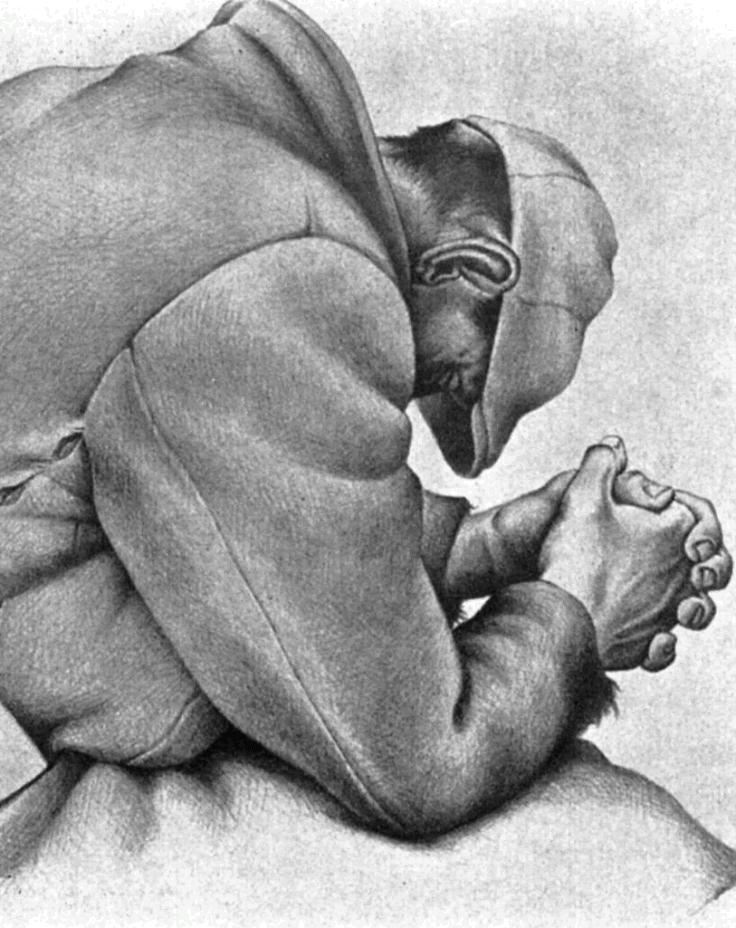
“Come to Me, all who are weary and heavy-laden, and I will give you rest.
Matthew 11:28-30
“Take My yoke upon you and learn from Me, for I am gentle and humble in heart, and you will find rest for your souls.
“For My yoke is easy and My burden is light.”
The Doctrine of Salvation

Saved from What?
The word, salvation, is a common term used in the world of Christianity. It is also associated by non-Christians with the Christian faith. Salvation is therefore known by the greater part of society as a term for a person being saved. But what are they being saved from? This is where the Christian concept of salvation is not properly understood. A good example of this is the story told by R.C. Sproul, a popular pastor, theologian, and founder of Ligonier Ministries. He recounts an occasion when he was a professor of theology at Temple University in the 1960’s. He had finished lunch and was walking across the campus back to his classroom when he was stopped by an eager young evangelist. The person not knowing that he was addressing a professor of theology, asked Sproul, “Are you saved?” Sproul responded by asking him, “Saved from what?” The would-be evangelist was surprised by this question, and he stumbled as he attempted to answer. He struggled for a time trying his best to give an explanation for salvation, but it was clear that he did not have a grasp on the concept of salvation. Unfortunately, this is the condition of many Christians who lack a biblical understanding of salvation.
Saved from Eternal Punishment
It is not difficult to determine that salvation indicates a saving from some dire circumstance. So, the answer to the above question is that we are saved from the consequences of sin.

Every person who has ever been born is under the curse of sin which brings death, spiritual death which is eternal punishment. Sin is disobedience and rebellion against God and God in executing His perfect justice must punish those who are guilty of violating His laws, by setting His wrath against them. Sin is the crime that each person is guilty of, and the verdict is death. There is a much deeper aspect of sin that must be considered in order to understand its consequences. The reader can access the teaching on the Doctrine of Sin on the drop-down window on the Doctrines tab. An excerpt from that instruction is provided below for convenience.
“The Doctrine of Sin must be considered in light of the Doctrine of Redemption and the Gospel Message. The Gospel message is that Christ died to pay the penalty for the sins of humanity. Without the consequences of sin there is no need for redemption. The Bible from beginning to end is the drama of redemption. Beginning with the Fall of Man by the disobedience of Adam, to the redemptive work of Christ, and finally to the complete victory over sin and death with the return of Christ and the destruction of the world—sin is the main villain in the drama. Sin is man’s mortal enemy and the cause of his destruction. God is the hero in the drama as He sends His son, Christ, to save man and to restore creation from the corruption caused by the effects of God’s wrath against sin and rebellion. Mankind’s redemption and salvation by the grace of God and the work of Christ can only be properly understood by comprehending the seriousness of sin.”
Salvation is the operation by which the condemned person is saved from the execution of their death sentence through the redeeming work of another. This redeemer exchanges his life for the life of the condemned person by taking the death sentence on himself and dying in their place. The penalty is carried out and the guilty person is freed, innocent of any charges. The redeemer has paid the full penalty of the crime. This is the true image of salvation, the redeemer is Christ, and His death on the cross paid the penalty for sins of all those who accept Him as their savior and redeemer through their faith.
Grace and Love in Salvation
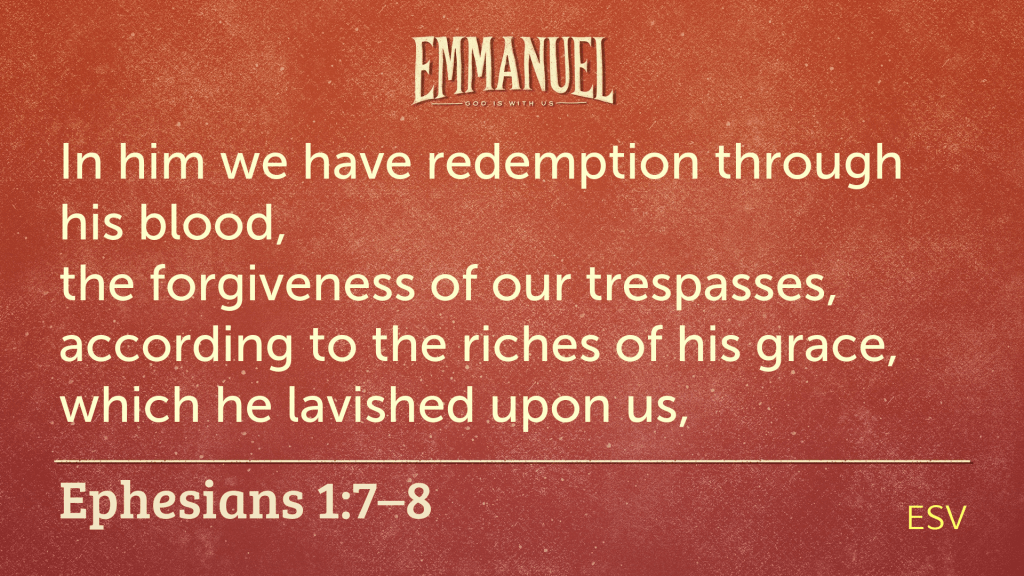
The Doctrine of Salvation intersectsand connects with several other doctrines and concepts, but none more so than love and grace. Salvation must be understood in terms of God’s grace, which He freely gives as a gift to those He loves. As the Apostle Paul explains in the verse above, we have redemption according to the riches of God’s grace which he lavishes upon those that are saved by the blood of Christ. God’s grace in salvation flows from God’s love where He sent His Son not because of our love for Him but because of His love for us.
“This is love: not that we loved God, but that he loved us and sent his Son as an atoning sacrifice for our sins.” (1 John 4:10)
Grace and love in salvation are expressed by God’s free act of reaching out to sinful humans and rescuing them from condemnation, even though they have done nothing to deserve this act of divine grace. The emphasis of grace is that it is not given because we have requested it, it is given as a free gift. The gift of salvation is precious beyond comparison due to the price that was paid for it. The believer’s redemption was paid for by the death of Christ by which He voluntarily suffered because of His love. This is the result of the richness of God’s grace toward us.
The Work of Salvation
The Doctrine of Salvation and the Drama of Redemption are closely related because mankind’s salvation is the main object of the Drama of Redemption. Man’s fall from grace is the subject of Act One in the drama as revealed in the book of Genesis. As the drama unfolds, humanity requires deliverance from the penalty of his disobedience. A deliverer is promised in the form of the promised Messiah. The drama continues through the Old Testament until the Savior appears in the New Testament who brings redemption through His own sacrifice and death–This is the work of salvation. The work of Christ on the cross satisfied God’s wrath against sin and it redeemed mankind from the condemnation of the penalty of sin. The concepts involved in this work include imputation, atonement, regeneration, justification, and sanctification. These processes are complex in their composition and effect thereby requiring each to be a doctrine of its own. These sub doctrines are included in the parent Doctrine of Salvation. When explaining or teaching on salvation it is necessary to include these other sub doctrines. And as mentioned earlier, salvation cannot be properly understood apart from an understanding of sin. One cannot know why they need to be saved if they don’t know what they are being saved from.
Definitions
salvation (Heb. yāša‘, nāṣal, Gr. sōteria, Lat. salvatio, from salvare, “to save”) God’s activities in bringing humans into a right relationship with God and with one another through Jesus Christ. They are saved from the consequences of their sin and given eternal life. Biblical images for salvation vary widely.
deliverance (Lat. deliberare, “to liberate”) The act of being freed, liberated from a constraint. It describes the liberation of Israel from Egypt (Exod. 14:13) and Israel’s future glory (Ps. 14:7; Isa. 51:5; 56:1). Theologically, it is liberation from the power of sin, through Jesus Christ.
grace (Heb. chēn; Gr. charis; Lat. gratia, “favor,” “kindness”) Unmerited favor. God’s grace is extended to sinful humanity in providing salvation and forgiveness through Jesus Christ that is not deserved, and withholding the judgment that is deserved (Rom. 3:24; Eph. 1:7; Titus 2:11). (In The Westminster Dictionary of Theological Terms.)
Redeemer — one who frees or delivers another from difficulty, danger, or bondage, usually by the payment of a ransom price. God Himself is the Redeemer of Israel, a fact mentioned 18 times—especially by the prophet Isaiah (Ps. 78:35; Is. 41:14). In the New Testament, Christ is viewed as the ultimate Redeemer. Jesus gave His life as “a ransom for many” (Mark 10:45). Thus, the apostle Paul speaks of believers as having “redemption through His blood” (Eph. 1:7). (In Nelson’s new illustrated Bible dictionary. Thomas Nelson, Inc.)
 Hosea 4:6 Teaching Ministry