
Sin in the Life of the Christian
A person accepts Christ as his Savior through faith and begins his life as a new believer. He understands that he has received salvation and has been forgiven for his sins and is no longer subject to the penalty of sin because it has been paid for by the death of Christ on the Christ. The new believer moves forward in his new Christian life imagining that he has received a form of sainthood where he is no longer subject to the temptations of sin. It is not long before he realizes that he is still tempted by the same sinful desires which he harbored before he was saved, and he also has committed various sins since then. He is bewildered by this turn of events and seeks answers. His pursuit for direction leads him to the discovery that he is not a saint, but only a sinner who has been saved. He still sins and will continue to sin during his lifetime. He needs more answers and guidance.
The answers are found in Scripture. The Apostle Paul explains the issue of remaining sin in the book of Romans. The opening verse, (Rom. 7:21-25), and the verse below, (Rom. 7:19-20), illustrates the battle with indwelling sin that each believer is engaged in as the desires of the flesh pull toward sin, while the mind desires to obey the law of God. This war is part of the sanctification process where the believer is undergoing a transformation of the mind which leads to greater knowledge of the full council of God.
“For the good that I want, I do not do, but I practice the very evil that I do not want. But if I am doing the very thing I do not want, I am no longer the one doing it, but sin which dwells in me.” (Rom. 7:19-20)
The struggle with sin is difficult because sin has great power to influence us. Sin has the power of temptation which is manipulated by the demonic forces who oppose the Kingdom of God. They stoke the fires of temptation according to our weaknesses. Paul gives us insight into the power of sin when he declares, “there is none that are righteous,” (Rom. 3:10), and “for all have sinned and fall short of the glory of God,” (Rom. 3:23). He also reveals his own struggle with sin as he describes it as a war that is being waged within himself where he engages in sin because of the sinful temptations that reside in him even though he desires to do good. Paul is using himself as an example of what all believers will encounter as they work through their own sanctification. All Christians will struggle with the power of sin as they strive to imitate Christ and be Christlike in righteousness.
The power of sin is at work in all people during the entire course of their lives. Believers are not exempt from the struggle with the power of sin. The difference between believers and unbelievers is that believers have been freed from the bondage to sin. Bondage to sin means that apart from Christ and the work of the Holy Spirit, persons have their wills inclined toward sin and are unable to resist its temptations. Believers are no longer controlled by the desire to sin, but they will struggle with the remnants of sin that remain in their bodies of flesh, which is the shadow of sin that has left its imprint in the mind. This is the purpose of the sanctification process which is the transformation of the mind to become conformed to the image of Christ. The Christian will always be engaged in a battle with the world, the flesh, and the devil.
Putting Sin to Death and Living Life in Christ

So, we have discussed why believers have to battle with sin—now we get to how to engage in the battle with sin. This is not to say that the believer will be free from sin, only that he or she will be able to fight the good fight of faith. The verse above, (1Tim. 6:11-12), gives us a battle plan against sin. The plan is simple, flee from the things that bring evil temptations and instead pursue those things that bring righteousness and godliness. (It is important to stress that the plan may be simple in design, but the warfare will be severe.) This verse also teaches that the battle with sin is a fight of faith. The believer’s faith in Christ is crucial in dealing with sin. Weak faith results in a weak defense, while strong faith brings a strong defense supported by the power of the Spirit. The battle against sin cannot be fought without the power of the indwelling Spirit. Connection to the indwelling Spirit is the foundation of a believer’s spiritual growth which is part of the sanctification process. This process brings with it suffering through the inner battle against residual sin and the battle against temptation. Resisting temptations and overcoming sinful habits will bring anxiety, anger, depression, and guilt. For these reasons it is necessary to return to the original biblical teachings on the struggles of the Christian as he/she transitions from sinner to saint. The teachings of Christ and His apostles clearly teach the tribulations associated with following Him. Those who are true followers of Christ are humble in spirit but bold in character. The true God of Scripture is a holy God who hates sin and requires repentance. His standards of conduct are high as exhibited by His Son, Christ, in His earthly ministry when He committed no sin. These standards are much too high to be achieved by man/woman alone without the help of the Holy Spirit. The conviction of sin by the Holy Spirit and repentance by the believer lead to the mortification of sin, (putting sin to death) and the vivification of the believer, (receiving life in Christ).
Mortification in simplest terms is the putting to death of sin in the life of the believer and vivification is the renewing of the person following mortification to becoming a new person in Christ. Another way to explain these concepts is that the battle against sin requires a defense and an offense. Mortification is the defense where the believer resists sin by striking at its root in the heart before it grows and becomes action. Vivification is the offense where the believer overcomes sinful desires and pursues righteousness by imitating Christ and being obedient to the commandments of God. A popular example of the battle against sin is the great Jonathan Edwards who was one of the principal agents of America’s Great Awakening. In a biography written with passages from his personal diary, Edwards describes his struggles with sin. He realized that he lacked the strength to overcome his indwelling sin and that only through the power of God could he defeat his inner corruptions. A diary entry describes his belief that only the power of Holy Spirit can overcome and defeat sin; “Saturday evening, Jan. 5.… Sin is not enough mortified. Without the influences of the Spirit of God, the old serpent would begin to rouse himself from his frozen state, and would come to life again.” This quote and the one following is from S.J. Lawson’s biography of Edwards.
“Every believer who would pursue holiness engages in the fight against sin. Sanctification is an ongoing war with the world, the flesh, and the Devil to gain the high ground of godliness. It demands wholehearted commitment from every Christian soldier. Victory will never come if you do not wage war on the battlefield of your heart. Edwards fought as a tireless warrior in the fight against sin, and thus provides great inspiration for all who would follow his example.”
Lawson, S.J. The Unwavering Resolve of Johnathon Edwards. (pg. 89).
The Weapon of Repentance

Many Christians neglect the work of repentance and therefore do not receive its benefits. However, because of ongoing sin, we must continually engage in acts of repentance in submission to the commandments of the Holy God that we are spiritually connected to. Unrepentant sin in the life of the believer repels the members of the Trinity and limits our growth. Though our salvation is sure because of our faith in Christ, our relationship to the persons of the Trinitarian Godhead becomes strained by our sin. Many Christians at times will suffer through times of spiritual darkness and a feeling of being distant from God. It may very well be because unrepentant sin is causing a separation in the relationship, where God has distanced Himself due to the pollution caused by sin. A life of constant repentance and prayer cleanses the believer’s spirit of pollution and reconciles the relationship.
Repentance is commonly associated only with the conversion of the new believer prior to his justification. The acknowledgement of sins and repentance by the person leads to faith and the acceptance of Christ as Savior for the new believer. While this act of repentance is necessary for the remission of sins, it is only the beginning of an action and pattern that is part of the Christian life. Just as repentance and faith are connected at the beginning of salvation, they are also connected throughout the life of the Christian. Faith is weakened by unrepentant sin, and it is strengthened through repentance. The remission of sin through repentance brings the forgiveness of our disobedience, by God through His grace. The believer’s spirit is refreshed, his faith is strengthened, and his bond with the Holy Spirit is not obstructed through continual repentance.
Walk by the Spirit
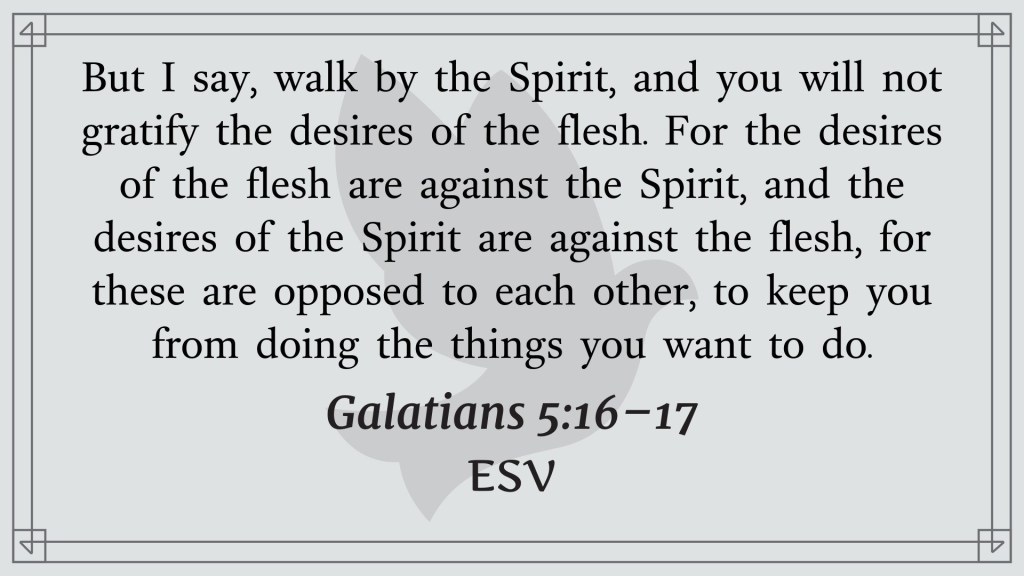
The most important protection that a believer has against the power of sin is the work of the Holy Spirit. As the verse above teaches, the desire of the Spirit and the desire of the flesh are in conflict with each other in the body of the believer. In order to overcome the power of sin the believer must submit to the power of the Spirit. This is accomplished by living and walking by the Spirit. To live by the Spirit is to be dependent on Him as we work through our sanctification to resist and overcome our old sinful desires and grow toward righteous behavior through seeking the desires of the Spirit. To walk with the Spirit is to walk in accordance with the direction and control of the Holy Spirit. The Spirit’s work is to direct us to the work of Christ in which we received redemption and His righteousness. This belief is the primary focus of the Christian life which keeps us Christ centered and subject to Him as Lord, King, and Savior. The Spirit fosters our relationship to Christ and is always directing us toward Him for our example of holiness and righteousness. In conjunction with this the Spirit guides us toward the truths of Scripture and illuminates our understanding which is necessary for our growth in knowledge. Growing in wisdom and knowledge leads us to maturity in the faith. Despite our maturity and growth, our battle with sin will continue as long we inhabit these bodies of flesh, and therefore the Spirit convicts us when in our weakness we yield to temptation. However, He continually leads us toward Godly conduct and away from wickedness and the forces of evil. Only the power of the Holy Spirit is capable of overcoming the inner desire of the flesh and the outer temptations of the spiritual powers and principalities of the forces of darkness. This is the key to prevailing in the good fight of faith against sin.
Final Instructions

The story of the life of King David is filled with the accounts of his sinful deeds. But it also records his repentance and close relationship with God. The Psalms give us his prayers for forgiveness and protection against enemies and his own sinful inclinations as recorded in the above Psalm, (Psalm 141:3-4). We can use the words of King David as instruction on how we should pray to God and petition Him for strength and power to keep our minds from evil thoughts and desires which are the source for sinful deeds. We must approach our lives of faith in all humbleness as we acknowledge our weaknesses which make it necessary for us to depend upon the Lord for victory over the power of the world, the flesh, and the devil.
 Hosea 4:6 Teaching Ministry