
Looking back on the history of mankind we can see periods of civilization where societies were more wicked as they embraced evil and rejected righteousness. An example is the dark ages where society declined into a primitive and barbaric state where violence ruled and the pursuit of knowledge stalled. This current age is such a time, as there seems to be a regression toward violence and tribalism. Public order and peace have been pushed aside in favor of chaos and lawlessness. Society is fracturing as truth has lost its meaning because emotion and personal feelings have replaced logic and critical thinking—The result of all this is that wickedness reigns and holiness is vanquished. The spread of Christianity defeated paganism, but now paganism is rising from the ashes and taking back Christianity’s gains.
As the fall into a dark age increases, the contrast between holiness and sinfulness becomes increasingly more evident. In other words, holiness and righteousness shine brightly like a guiding light on a dark night. The hearts of good people who have not abandoned their minds to godless beliefs and ideas seek a return to times of peace, order, and holiness. Even Christians, who have the Scriptures but lack spiritual mentorship and direction search for guides to holiness. Those who search for holy living will be led to Christ, those who embrace the darkness will find that the devil has become their guide.
The Puritans were a community of believers who saw the decline of the Church as it placed politics above faithfulness to Scripture, and they worked to purify it through holy and righteous living. They faced much adversity and were harshly persecuted by members of their own church body as well as those outside the church who embraced sinful lifestyles and hated uncompromising holy Christians—like many in our current times. The Puritans held high academic standards for their clergy and leaders which produced great scholars and theologians. These Puritan scholars wrote many books and essays for instruction on righteousness and holy living. They emphasized a return to the virtues exemplified by Christ in His earthly ministry that defined holiness. These virtues include purity, humility, nobleness, compassion, truthfulness, honesty, patience, gentleness, faithfulness, forgiveness, generosity, and loving kindness. We would struggle to find many of these virtues in modern times. The works of the Puritans have been neglected and forgotten through time but have been rediscovered and updated for new generations of readers. This section is devoted to highlighting and promoting the works of the Puritans. May they guide you through your sanctification process and toward a life devoted to holy living.
John Owen and the Mortification of Sin
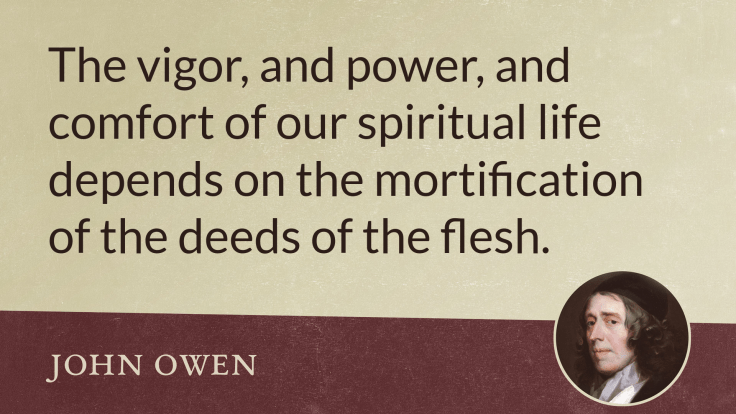
John Owen

John Owen (1616-1683) was a prominent English Puritan theologian, pastor, and writer. He became a chaplain and tutor before entering pastoral ministry and writing theological work. He also served as vice-chancellor of Oxford University. Owen was a prolific writer, producing over 80 works in 41 years, many of which became classics. He is renowned for his high view of God, deep theological convictions, and emphasis on personal holiness. Owen’s impact on Puritan and English history was significant, and his writings continue to influence modern Christian thought.
Mortification
Mortification in simplest terms is the putting to death of sin in the life of the believer. Another way to explain it is that the battle against sin requires a defense and an offense. Mortification is the defense where the believer resists sin by striking at its root in the heart before it grows and becomes action.
Holy Living Through the Mortification of Sin
The Puritans strived to live lives of holiness which reflected the holiness of God. They knew that sin was a great obstacle to holy living, therefore it had to be resisted through mortification. The power of sin is at work in all people during the entire course of their lives. Believers are not exempt from the struggle with the power of sin, and the struggle is difficult because sin has great power to influence us. They will continually struggle with the remnants of sin that remain in their bodies of flesh, because sin has left its imprint in the mind. This is the purpose of the sanctification process, which is the transformation of the mind to become conformed to the image of Christ. The Christian will always be engaged in a battle with the world, the flesh, and the devil. John Owen observed that Christians were well aware of why sin was to be resisted, but they were not properly instructed in how to resist it. His response was to write a type of battle plan for Christians to use in their struggles against sin—“The Mortification of Sin.”
Owen encourages Christians in their battle against sin by emphasizing the goodness and mercy of God in their lives as they grieve Him through their ongoing and unrepentant sin. Christians should be motivated to mortify sin because of their love of the triune God; loving Father, Christ our suffering savior, and the indwelling Spirit. He presents five issues to consider in relation to the mortification of sin.
- Believers who are freed from the condemnation of sin should work daily to destroy the indwelling power of sin.
- Eternal life is the free gift of God through faith in Christ, therefore we should continually acknowledge and cherish this gift by our active engagement in the battle to mortify sin.
- Some deep temptations of the flesh are beyond our power to oppose and it is only through the power of the indwelling Spirit that these sins can be defeated.
- Indwelling sin and lust are the foundations of all sinful action, therefore all actions to mortify sin should be directed at the root, which is the indwelling sin.
- The promise of eternal life should be a motivation for our mortification of sin. Eternal life also extends into our spiritual life in Christ where we experience His joy, comfort, and passion.
He moves on to explain three ways in which the Holy Spirit mortifies our sin, (1). the Spirit causes our hearts to overflow with grace and the fruits of the Spirit which oppose the desires of the flesh, (2). the Spirit is actively working to destroy the root of sin in our lives in a progressive manner, and (3). the Spirit strengthens our Union with Christ which increases faith. Owen adds that the mortification of sin is an ongoing battle throughout life and is not a one-time event. This battle requires a constant and lifelong relationship and reliance on the Spirit for holiness. He also gives instruction in addressing a certain particular and powerful sinful temptation. Identifying this sin and treating it as a dangerous threat is the first priority. This if followed by weakening its control by acting first before its temptation takes hold and progresses into action. Finally, it is necessary to call on the power of the Spirit through prayer to mortify the desire of the sin in the believer. He cautions that in the battle against deeply rooted sin a believer may discover that the root of a certain sin is actually part of a greater root system which is tangled together with other sinful roots. So, be prepared for what you will find buried deep inside your sinful heart.
Mortification is a difficult but essential aspect of the spiritual life of a Christian and should be approached in all seriousness as it leads to becoming more Christlike, which is the goal of sanctification. Owen repeats his belief that mortification is dependent on the power of the Spirit and His involvement in the life of the believer in the ongoing battle with the power of indwelling sin–And this is our strength, that we are not alone in our struggle, we are in alliance with the mighty triune God. As we engage in battle together, we draw closer as we venture through the deepest and most personal areas of our lives with our most beloved God.

 Hosea 4:6 Teaching Ministry